Porisma

Worked solution

Find the locus of a fixed-ratio point between a line and a plane

Line l is x−1=(y+2)/(−1)=(z−1)/2x-1=(y+2)/(-1)=(z-1)/2, and plane p1 has equation r=αi+(−α+β)j+(12+2α−5β)k\mathbf r=\alpha\mathbf i+(-\alpha+\beta)\mathbf j+(12+2\alpha-5\beta)\mathbf k, α,β real.

(i) Show l is parallel to p1. mark

(ii) A,B vary independently on l,p1. C lies on segment AB with BC=2AC. Show C lies on a plane as A,B vary. marks

(iii) Calling this plane p2, show its equation is r⋅(3,5,1)=0\mathbf r\cdot(3,5,1)=0. marks

(iv) Find the perpendicular distance between l,p2. Hence or otherwise find the distance between p1,p2. marks

[2016/RI/Promo/12]

CJC · Review problems · Question 13

Answer

p2:r⋅(3,5,1)=0r\cdot(3,5,1)=0; distance(l,p2)6/356/\sqrt{35}; distance(p1,p2)12/3512/\sqrt{35}.

(i) Method 1: identify a shared direction

l:r=(1,−2,1)+λ(1,−1,2)l:\mathbf r=(1,-2,1)+\lambda(1,-1,2); p1:r=(0,0,12)+α(1,−1,2)+β(0,1,−5)p_1:\mathbf r=(0,0,12)+\alpha(1,-1,2)+\beta(0,1,-5). The direction (1,−1,2)(1,-1,2) is parallel to both, so the line is parallel to the plane. It is not contained because its point has normal constant −6 rather than 12.

How did this part go?

(i) Method 2: use the plane normal

A normal is (1,−1,2)×(0,1,−5)=(3,5,1)(1,-1,2)\times(0,1,-5)=(3,5,1). Its dot product with the line direction is 3−5+2=03-5+2=0, again proving the parallel direction.

How did this part go?

(ii) Apply the section formula and collect free parameters

OA=(1,−2,1)+λ(1,−1,2)OA=(1,-2,1)+\lambda(1,-1,2) and OB=(0,0,12)+α(1,−1,2)+β(0,1,−5)OB=(0,0,12)+\alpha(1,-1,2)+\beta(0,1,-5). Since BC=2AC,OC=(OB+2OA)/3OC=(OB+2OA)/3. Thus

OC=13(2,−4,14)+α+2λ3(1,−1,2)+β3(0,1,−5).\begin{aligned}&OC\\ & =\frac13(2,-4,14)\\ &{}+\frac{\alpha+2\lambda}{3}(1,-1,2)\\ &{}+\frac\beta3(0,1,-5).\end{aligned}

The last two coefficients can vary independently over all real numbers, giving a plane through (2,−4,14)/3(2,-4,14)/3 parallel to those two nonparallel directions.

How did this part go?

(iii) Evaluate the locus plane constant

The same two directions give normal (3,5,1)(3,5,1). Hence p2:r⋅(3,5,1)=13(2,−4,14)⋅(3,5,1)=13(6−20+14)=0p_2:\mathbf r\cdot(3,5,1)=\frac13(2,-4,14)\cdot(3,5,1)=\frac13(6-20+14)=0, as required.

How did this part go?

(iv) Distance from l to p2

Use the line point (1,−2,1)(1,-2,1): distance=∣(1,−2,1)⋅(3,5,1)∣/9+25+1=∣3−10+1∣/35=6/35|(1,-2,1)\cdot(3,5,1)|/\sqrt{9+25+1}=|3-10+1|/\sqrt{35}=6/\sqrt{35}.

How did this part go?

(iv) Plane separation, method 1: the section ratio

p1,p2 are parallel and the section ratio places p2 one third of the way from the line’s parallel level toward p1. Therefore the p1-to-p2 distance is twice the l-to-p2 distance:2(6/35)=12/352(6/\sqrt{35})=12/\sqrt{35}.

How did this part go?

(iv) Plane separation, method 2: plane constants

p1 has scalar-product equation r⋅(3,5,1)=(0,0,12)⋅(3,5,1)=12\mathbf r\cdot(3,5,1)=(0,0,12)\cdot(3,5,1)=12. Therefore its distance from p2 is ∣12−0∣/35=12/35|12-0|/\sqrt{35}=12/\sqrt{35}.

How did this part go?

Compare your sketch

Expand diagram

Use the scrollbars or arrow keys to inspect details.
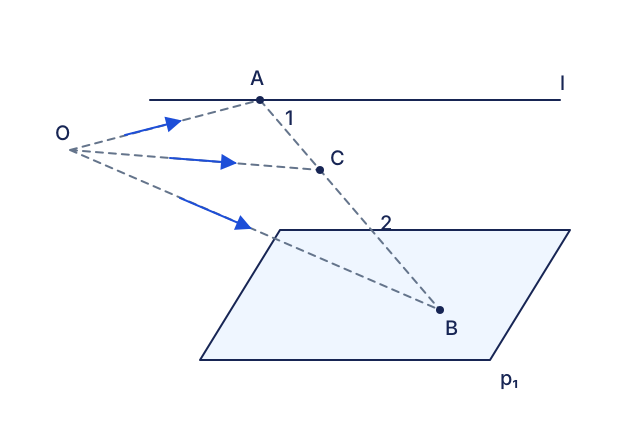
A varies on line l and B varies independently in plane p1. C lies on AB with AC:CB=1:2. Position-vector arrows O→A,O→C,O→B and dashed section line show OC=(2OA+OB)/3. The independent schematic preserves the source point roles, ratio and line parallel to the plane, without using screen distances as spatial coordinates.

Common mistakes

The line and p1 do not intersect; the locus plane lies at a fixed signed level between their parallel levels.

Solution notes

All 4 asks, both parallelism methods, full locus parameter derivation, both plane-distance methods and original ratio/position-vector figure retained.

Read the hint