Porisma
All chapter practice

Vectors: planes, normals and distances

Practice section 7 of 7

Questions 37–40 in this collection

Practice questions

Review practice · 1 of 4

Reflect a light ray using the plane normal

A=(4,1,0), and line l1 is x−3=−y=(z−3)/2x-3=-y=(z-3)/2.

(i) Find plane π containing A and perpendicular to l1, in scalar-product form. [3]

(ii) Find P on l1 with AP perpendicular to l1. [3]

A ray travels along l2 from (0,−9,1) to P and reflects in π along l3, in the same plane as l1,l2, with equal angles between l1,l2 and l1,l3. Find l3. [6]

[2016/SAJC/Promo/11]

CJC · Review problems · Question 12

Solution

Review practice · 2 of 4

Find the locus of a fixed-ratio point between a line and a plane

Line l is x−1=(y+2)/(−1)=(z−1)/2x-1=(y+2)/(-1)=(z-1)/2, and plane p1 has equation r=αi+(−α+β)j+(12+2α−5β)k\mathbf r=\alpha\mathbf i+(-\alpha+\beta)\mathbf j+(12+2\alpha-5\beta)\mathbf k, α,β real.

(i) Show l is parallel to p1. [1]

(ii) A,B vary independently on l,p1. C lies on segment AB with BC=2AC. Show C lies on a plane as A,B vary. [3]

(iii) Calling this plane p2, show its equation is r⋅(3,5,1)=0\mathbf r\cdot(3,5,1)=0. [2]

(iv) Find the perpendicular distance between l,p2. Hence or otherwise find the distance between p1,p2. [3]

[2016/RI/Promo/12]

CJC · Review problems · Question 13

Solution

Review practice · 3 of 4

Trace and reflect two rays inside a cuboid

The closed cuboid has OA = 12 cm, OC = 10 cm, OE = 5 cm. O is the origin; perpendicular unit vectors i,j,k are parallel to OA, OC, OE. Vertex order is as in the diagram.

A yellow ray starts at O in direction i+2j+2k\mathbf i+2\mathbf j+2\mathbf k. A blue ray starts at A and passes through H on ED with EH:ED=2:5.

(i) Will the yellow and blue paths cross? Explain clearly. [4]

(ii) Find the angle between the blue ray and plane DEFG. [2]

(iii) Find X where the yellow ray meets DEFG. [3]

(iv) DEFG is reflective. The yellow ray reflects and meets OABC at Y. Find the area of triangle OXY. [3]

Expand diagram

Use the scrollbars or arrow keys to inspect details.
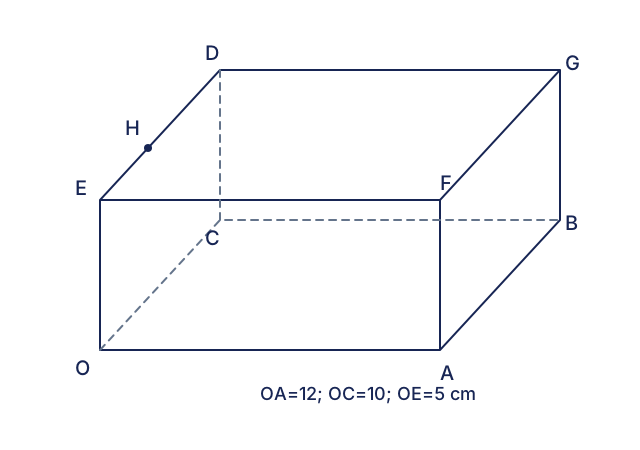
Cuboid OABC as bottom face and EFGD as the corresponding top face: O below E, A below F, B below G, C below D. OA=12 along i, OC=10 along j, OE=5 along k; these axes are perpendicular. Hidden edges OC, CB, CD are dashed. The perspective schematic reproduces all eight source vertices; it is not a metric screen projection. H on ED is added at EH:ED=2:5 for the blue-ray construction.

[2017/AJC/MYE/J2/I/8]

CJC · Review problems · Question 14

Solution

Review practice · 4 of 4

Find a reflected laser line and check a sensor threshold

A laser source at O projects an incident beam with direction i+2j+k\mathbf i+2\mathbf j+\mathbf k. It hits a mirror at P with angle θ and reflects at the same angle. The mirror is −x+2y+3z=12-x+2y+3z=12.

(i) Find the acute angle θ the beam makes with the mirror.

(ii) By finding O′, the image of O in the mirror, find a vector equation of the line containing the reflected beam.

(iii) A sensor at (3,1,0)(3,1,0) must be less than 2 units from either the incident or reflected beam to work properly. Determine whether it will work.

Expand diagram

Use the scrollbars or arrow keys to inspect details.
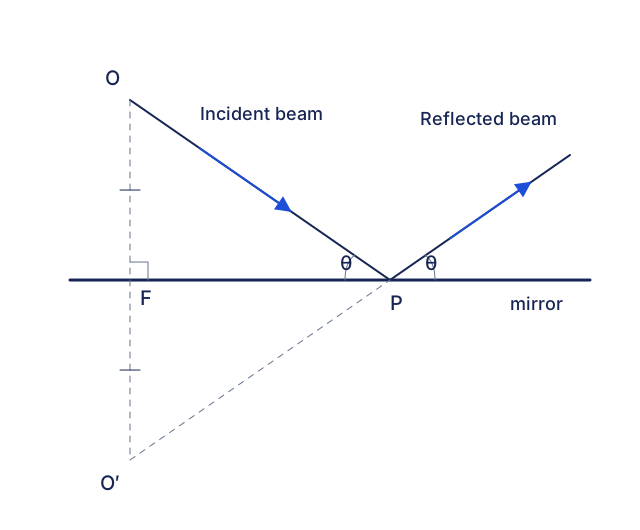
Mirror shown as a horizontal line through P. O lies above it, O′ the reflection below it; their common foot F is on the mirror and OF=FO′. Incident O→P and reflected P→upper-right beams make equal acute angles theta with the mirror. Dashed O′P extends the reflected line backward. Independent planar reconstruction of the source optical diagram, not a projection of its spatial coordinates.

[YJC Prelim 9758/2017/01/Q12]

CJC · Review problems · Question 15

Solution

Back to all practice questions