Worked solution
Find the locus of a fixed-ratio point between a line and a plane
Line l is , and plane p1 has equation , α,β real.
(i) Show l is parallel to p1. mark
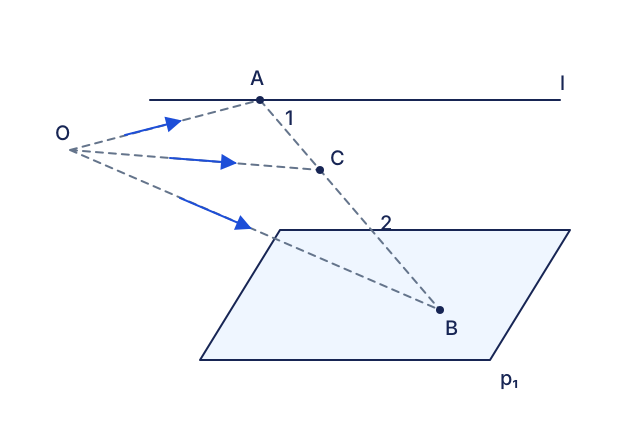
(ii) A,B vary independently on l,p1. C lies on segment AB with BC=2AC. Show C lies on a plane as A,B vary. marks
(iii) Calling this plane p2, show its equation is . marks
(iv) Find the perpendicular distance between l,p2. Hence or otherwise find the distance between p1,p2. marks
[2016/RI/Promo/12]
CJC · Review problems · Question 13
Answer
p2:; distance(l,p2); distance(p1,p2).
(i) Method 1: identify a shared direction
; . The direction is parallel to both, so the line is parallel to the plane. It is not contained because its point has normal constant −6 rather than 12.
(i) Method 2: use the plane normal
A normal is . Its dot product with the line direction is , again proving the parallel direction.
(ii) Apply the section formula and collect free parameters
and . Since BC=2AC,. Thus
The last two coefficients can vary independently over all real numbers, giving a plane through parallel to those two nonparallel directions.
(iii) Evaluate the locus plane constant
The same two directions give normal . Hence , as required.
(iv) Distance from l to p2
Use the line point : distance=.
(iv) Plane separation, method 1: the section ratio
p1,p2 are parallel and the section ratio places p2 one third of the way from the line’s parallel level toward p1. Therefore the p1-to-p2 distance is twice the l-to-p2 distance:.
(iv) Plane separation, method 2: plane constants
p1 has scalar-product equation . Therefore its distance from p2 is .
Compare your sketch
Expand diagramFit diagram to page
Use the scrollbars or arrow keys to inspect details.
Common mistakes
The line and p1 do not intersect; the locus plane lies at a fixed signed level between their parallel levels.
Solution notes
All 4 asks, both parallelism methods, full locus parameter derivation, both plane-distance methods and original ratio/position-vector figure retained.