Worked solution
Trace and reflect two rays inside a cuboid
The closed cuboid has OA = 12 cm, OC = 10 cm, OE = 5 cm. O is the origin; perpendicular unit vectors i,j,k are parallel to OA, OC, OE. Vertex order is as in the diagram.
A yellow ray starts at O in direction . A blue ray starts at A and passes through H on ED with EH:ED=2:5.
(i) Will the yellow and blue paths cross? Explain clearly. marks
(ii) Find the angle between the blue ray and plane DEFG. marks
(iii) Find X where the yellow ray meets DEFG. marks
(iv) DEFG is reflective. The yellow ray reflects and meets OABC at Y. Find the area of triangle OXY. marks
Expand diagramFit diagram to page
Use the scrollbars or arrow keys to inspect details.
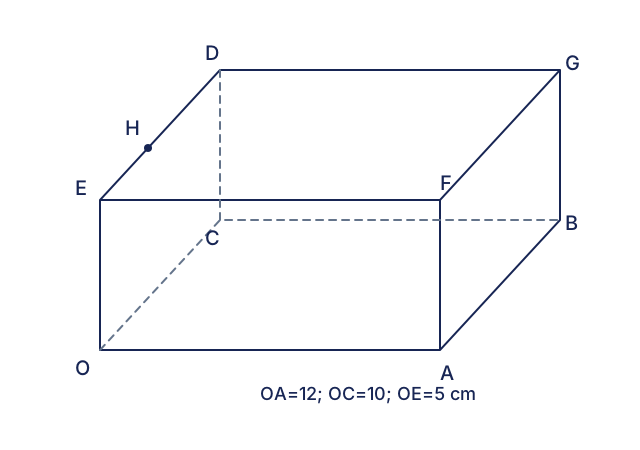
[2017/AJC/MYE/J2/I/8]
CJC · Review problems · Question 14
Answer
No crossing; angle 21.6° or 0.376rad; X=(2.5,5,5); area (OXY) cm²≈28.0 cm².
(i) Parameterise both paths
, , and H=(0,4,5), so . Blue:; yellow:. Use λ,μ≥0 for rays, while the printed source uses real parameters for the supporting lines.
(i) Check all coordinates
An intersection requires , , . The last two force λ=μ=0, contradicting the first equation. Even the supporting lines do not intersect, so the ray paths do not cross.
(ii) Use the top-face normal
DEFG is z=5, with normal or its unit version . Thus . Hence θ=21.6°(1d.p.) or 0.376rad(3s.f.).
(iii) Reach the top plane
gives 2μ=5, μ=2.5. Hence .
(iv) Reflection geometry and method 1: cross product
Let Z be the foot of X on OABC. Then and Z=(2.5,5,0). Reflection at horizontal z=5 reverses the vertical ray component, so Y=(5,10,0), with Z the midpoint of OY. Thus area (OXY)= cm², or 28.0 cm²(3s.f.). The printed component matrix reverses the cross-product factors relative to its preceding magnitude expression; either order has the same magnitude.
(iv) Method 2: base and height
The two right triangles share height XZ=5 and each base has length . Hence total area= cm².
Common mistakes
The cuboid’s top plane is z=5. Reflection reverses the vertical component, not the horizontal components.
Solution notes
All 4 asks, both triangle-area methods and all source ray/angle calculations retained. All 8 cuboid vertices reconstructed; H and Y coordinates explain source steps without treating the perspective sketch as metric. Q15 heading starts on PDF 34 but its actual prompt begins PDF 35.