Worked solution
Find a reflected laser line and check a sensor threshold
A laser source at O projects an incident beam with direction . It hits a mirror at P with angle θ and reflects at the same angle. The mirror is .
(i) Find the acute angle θ the beam makes with the mirror.
(ii) By finding O′, the image of O in the mirror, find a vector equation of the line containing the reflected beam.
(iii) A sensor at must be less than 2 units from either the incident or reflected beam to work properly. Determine whether it will work.
Expand diagramFit diagram to page
Use the scrollbars or arrow keys to inspect details.
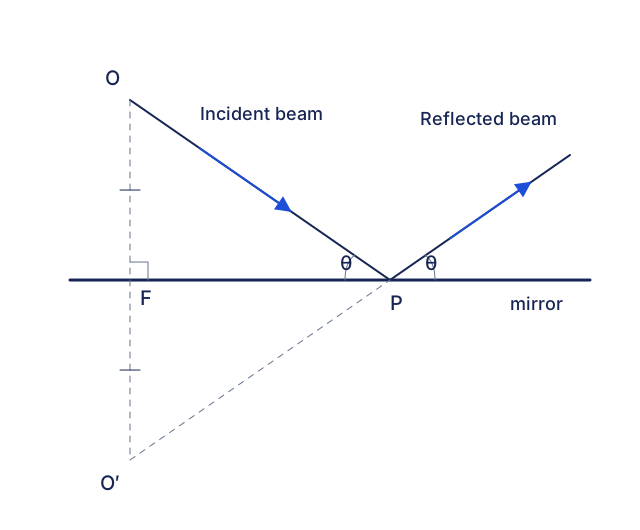
[YJC Prelim 9758/2017/01/Q12]
CJC · Review problems · Question 15
Answer
θ=40.9°; ; reflected line ; sensor will not work, since both distances exceed 2.
(i) Use a line-plane sine
Normal and incident direction give . Therefore θ=40.9°.
(ii) Reflect the source through its plane foot
Let F be the foot from O. Set ; since F lies in the mirror,, so λ=6/7. Hence , and the position vector of O′ is that same vector because O is the origin.
(ii) Find the incidence point P
. The mirror condition gives , so 6μ=12, μ=2 and .
(ii) Parameterise the reflected supporting line
. Thus the reflected line is , γ real. The outgoing beam uses γ≥0.
(iii) Distance to the incident path
Let B=(3,1,0). The supporting-line distance is . The perpendicular foot parameter 5/6 lies within the physical incident segment 0≤μ≤2, so this is also the beam-segment distance.
(iii) Distance to the reflected path and conclusion
. Its cross product with is , so the distance is . The perpendicular foot parameter 29/294 is nonnegative, so it lies on the outgoing ray. Neither beam is less than 2 units away; the sensor will not work properly.
Common mistakes
Check that a supporting-line distance applies to the actual beam segment or outgoing ray. Both foot parameters are valid here.
Solution notes
All 3 asks and source calculations retained with the original optical diagram reconstructed. This question has no printed marks; none invented. Q15 heading on PDF 34 retained in its native transcript alongside PDF 35–37. Additional foot-parameter checks justify using line distances for the actual beams.