Porisma

Worked solution

Find a circle–parabola area and half-turn volume

Use x=12cos⁡θx=\sqrt{12}\cos\theta to show that ∫0312−x2 dx=π+33/2\displaystyle\int_0^{\sqrt3}\sqrt{12-x^2}\,dx=\pi+3\sqrt3/2. Region AA is bounded by y=x2y=x^2 and a minor arc of x2+y2=12x^2+y^2=12.

(i) Find its exact area.

(ii) Find the exact volume when AA rotates through π\pi radians about the y-axis.

Expand diagram

Use the scrollbars or arrow keys to inspect details.
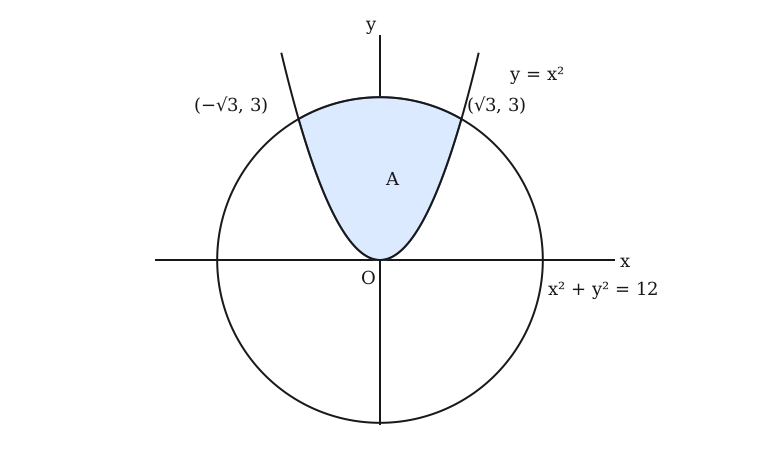
Circle x squared plus y squared equals 12 and parabola y=x squared. Region A lies above the parabola and below the upper minor circle arc, between intersections (minus square root 3,3) and (square root 3,3), symmetrically on both sides of the y-axis.

[2008/TJC/Promo/13]

CJC · Discussion · Question 7

Answer

Preliminary integral π+33/2\pi+3\sqrt3/2; area 2π+32\pi+\sqrt3; volume π(163−45/2)\pi(16\sqrt3-45/2).

Prove the preliminary integral by substitution

dx=−12sin⁡θ dθdx=-\sqrt{12}\sin\theta\,d\theta. The bounds x=0,3x=0,\sqrt3 correspond to θ=π/2,π/3\theta=\pi/2,\pi/3. Since sine is positive here, the integral becomes 12∫π/3π/2sin⁡2θ dθ=6[θ−12sin⁡2θ]π/3π/2=π+33/212\int_{\pi/3}^{\pi/2}\sin^2\theta\,d\theta=6[\theta-\tfrac12\sin2\theta]_{\pi/3}^{\pi/2}=\pi+3\sqrt3/2.

How did this part go?

(i) Find the intersections and subtract the lower curve

x2+x4=12x^2+x^4=12 gives (x2+4)(x2−3)=0(x^2+4)(x^2-3)=0, so the real intersections are (±3,3)(\pm\sqrt3,3). By symmetry, the area is 2[∫0312−x2dx−∫03x2dx]=2π+32[\int_0^{\sqrt3}\sqrt{12-x^2}dx-\int_0^{\sqrt3}x^2dx]=2\pi+\sqrt3 square units.

How did this part go?

(ii) Choose the horizontal radius in two pieces

The region straddles the y-axis. Rotating its positive and negative x halves through π\pi sweeps complementary semicircles, so each horizontal segment produces a full disc. For 0≤y≤30\le y\le3, radius squared is yy; for 3≤y≤123\le y\le\sqrt{12}, it is 12−y212-y^2. Thus V=π∫03y dy+π∫312(12−y2)dy=π(163−45/2)V=\pi\int_0^3y\,dy+\pi\int_3^{\sqrt{12}}(12-y^2)dy=\pi(16\sqrt3-45/2) cubic units.

How did this part go?

Common mistakes

A half-turn of a region on both sides of the axis can sweep a full solid.

Read the hint