Porisma

Discussion questions · Section 2 of 2

Questions 7–9 in this collection

Find a circle–parabola area and half-turn volume · Compute a composite solid by two methods · +1 more

All chapter practiceAll discussion questions
  1. 7

    Use x=12cos⁡θx=\sqrt{12}\cos\theta to show that ∫0312−x2 dx=π+33/2\displaystyle\int_0^{\sqrt3}\sqrt{12-x^2}\,dx=\pi+3\sqrt3/2. Region AA is bounded by y=x2y=x^2 and a minor arc of x2+y2=12x^2+y^2=12.

    (i) Find its exact area.

    (ii) Find the exact volume when AA rotates through π\pi radians about the y-axis.

    Expand diagram

    Use the scrollbars or arrow keys to inspect details.
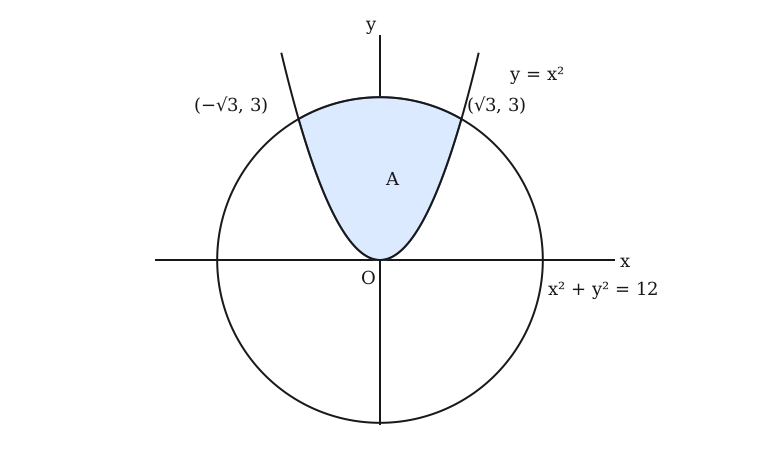
    Circle x squared plus y squared equals 12 and parabola y=x squared. Region A lies above the parabola and below the upper minor circle arc, between intersections (minus square root 3,3) and (square root 3,3), symmetrically on both sides of the y-axis.
    Circle x squared plus y squared equals 12 and parabola y=x squared. Region A lies above the parabola and below the upper minor circle arc, between intersections (minus square root 3,3) and (square root 3,3), symmetrically on both sides of the y-axis.
    Circle x squared plus y squared equals 12 and parabola y=x squared. Region A lies above the parabola and below the upper minor circle arc, between intersections (minus square root 3,3) and (square root 3,3), symmetrically on both sides of the y-axis.

    [2008/TJC/Promo/13]

    CJC · Discussion · Question 7

  2. 8

    Region RR is bounded by y=2xy=2x, y=3/2y=3/2, the x-axis and y=(3x2−1)/x2y=\sqrt{(3x^2-1)/x^2}, as shown. Find the volume when RR rotates through 2π2\pi about the x-axis, correct to three decimal places.

    Expand diagram

    Use the scrollbars or arrow keys to inspect details.
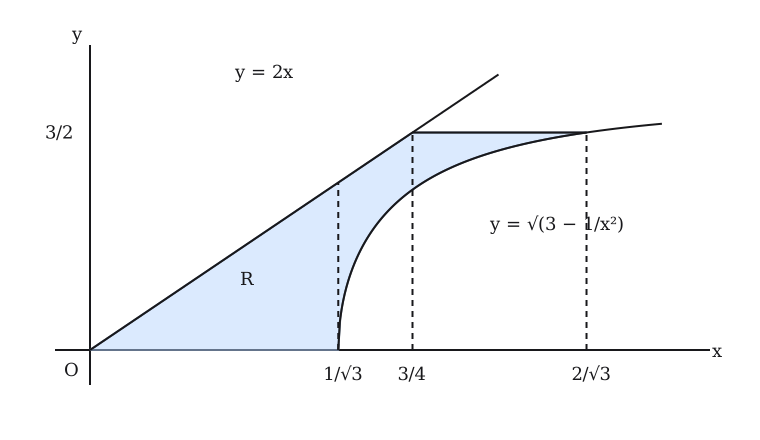
    Region R is above the x-axis until x=1/square root 3, then above the curve square root of (3 minus 1/x squared). Its upper boundary is y=2x until x=3/4 and y=3/2 afterwards, ending at x=2/square root 3.
    Region R is above the x-axis until x=1/square root 3, then above the curve square root of (3 minus 1/x squared). Its upper boundary is y=2x until x=3/4 and y=3/2 afterwards, ending at x=2/square root 3.
    Region R is above the x-axis until x=1/square root 3, then above the curve square root of (3 minus 1/x squared). Its upper boundary is y=2x until x=3/4 and y=3/2 afterwards, ending at x=2/square root 3.

    [2007/HCI/I/11(modified)]

    CJC · Discussion · Question 8

  3. 9

    Curve CC is y=3x/(4−x)y=\sqrt{3x/(4-x)}, 0≤x<40\le x<4. Region RR is bounded by CC, y=3y=3 and the y-axis. It rotates through 2π2\pi about y=3y=3. Write the equation after translating CC three units down, and hence find the solid volume.

    Expand diagram

    Use the scrollbars or arrow keys to inspect details.
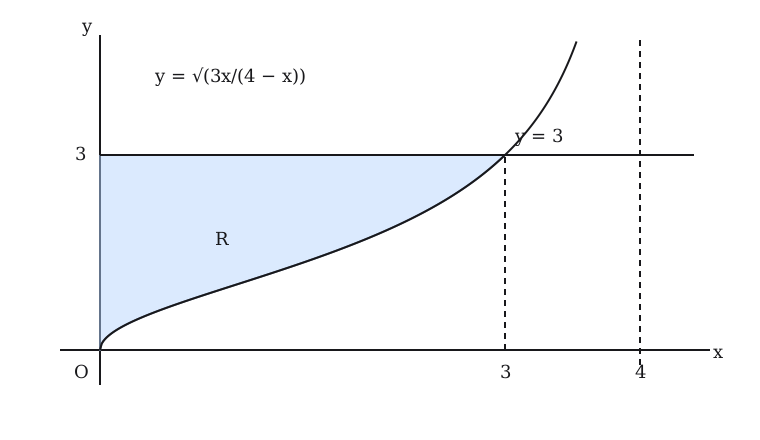
    Curve y=square root of 3x/(4 minus x) starts at the origin and meets the horizontal rotation axis y=3 at (3,3); x=4 is a vertical asymptote. Region R is shaded between y=3, the curve and the y-axis from x=0 to x=3.
    Curve y=square root of 3x/(4 minus x) starts at the origin and meets the horizontal rotation axis y=3 at (3,3); x=4 is a vertical asymptote. Region R is shaded between y=3, the curve and the y-axis from x=0 to x=3.
    Curve y=square root of 3x/(4 minus x) starts at the origin and meets the horizontal rotation axis y=3 at (3,3); x=4 is a vertical asymptote. Region R is shaded between y=3, the curve and the y-axis from x=0 to x=3.

    [2016/RVHS/II/4(modified)]

    CJC · Discussion · Question 9

Back to all questions