Porisma

Worked solution

Compute a composite solid by two methods

Region RR is bounded by y=2xy=2x, y=3/2y=3/2, the x-axis and y=(3x2−1)/x2y=\sqrt{(3x^2-1)/x^2}, as shown. Find the volume when RR rotates through 2π2\pi about the x-axis, correct to three decimal places.

Expand diagram

Use the scrollbars or arrow keys to inspect details.
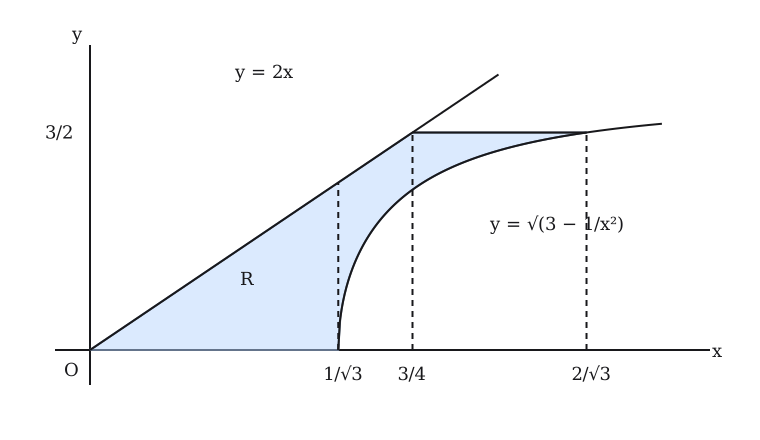
Region R is above the x-axis until x=1/square root 3, then above the curve square root of (3 minus 1/x squared). Its upper boundary is y=2x until x=3/4 and y=3/2 afterwards, ending at x=2/square root 3.

[2007/HCI/I/11(modified)]

CJC · Discussion · Question 8

Answer

V≈1.907V\approx1.907 cubic units (3 decimal places).

Identify the boundary transitions

The line meets y=3/2y=3/2 at x=3/4x=3/4. The positive square-root curve meets the x-axis at x=1/3x=1/\sqrt3 and meets y=3/2y=3/2 at x=2/3x=2/\sqrt3. Its squared radius is 3−1/x23-1/x^2.

How did this part go?

Method 1: cone plus cylinder minus the curved solid

V=π3(3/2)2(3/4)+π(3/2)2(2/3−3/4)−π∫1/32/3(3−1/x2)dxV=\tfrac\pi3(3/2)^2(3/4)+\pi(3/2)^2(2/\sqrt3-3/4)-\pi\int_{1/\sqrt3}^{2/\sqrt3}(3-1/x^2)dx. The subtraction integral is [3x+1/x]1/32/3=3/2[3x+1/x]_{1/\sqrt3}^{2/\sqrt3}=\sqrt3/2. Therefore V=π(3−9/8)≈1.907V=\pi(\sqrt3-9/8)\approx1.907 cubic units.

How did this part go?

Method 2: integrate the two outer radii and subtract the inner radius

V=π∫03/4(2x)2dx+π∫3/42/3(3/2)2dx−π∫1/32/3(3−1/x2)dxV=\pi\int_0^{3/4}(2x)^2dx+\pi\int_{3/4}^{2/\sqrt3}(3/2)^2dx-\pi\int_{1/\sqrt3}^{2/\sqrt3}(3-1/x^2)dx. This gives the same π(3−9/8)≈1.907\pi(\sqrt3-9/8)\approx1.907 cubic units (3 decimal places).

How did this part go?

Common mistakes

The square root disappears when the radius is squared; do not square the rational expression again.

Read the hint