Porisma

Worked solution

Translate a rotation axis before integrating

Curve CC is y=3x/(4−x)y=\sqrt{3x/(4-x)}, 0≤x<40\le x<4. Region RR is bounded by CC, y=3y=3 and the y-axis. It rotates through 2π2\pi about y=3y=3. Write the equation after translating CC three units down, and hence find the solid volume.

Expand diagram

Use the scrollbars or arrow keys to inspect details.
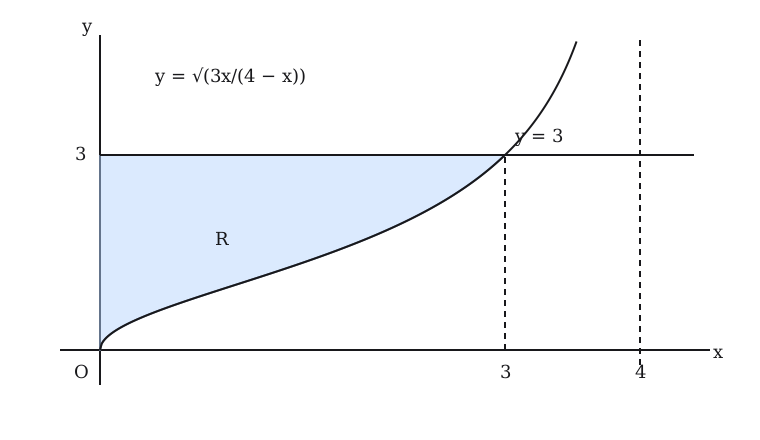
Curve y=square root of 3x/(4 minus x) starts at the origin and meets the horizontal rotation axis y=3 at (3,3); x=4 is a vertical asymptote. Region R is shaded between y=3, the curve and the y-axis from x=0 to x=3.

[2016/RVHS/II/4(modified)]

CJC · Discussion · Question 9

Answer

Translated curve y=3x/(4−x)−3y=\sqrt{3x/(4-x)}-3; volume 28.628.6 cubic units (3 significant figures).

Translate the curve and find the terminal x-value

The translated curve is y=3x/(4−x)−3y=\sqrt{3x/(4-x)}-3. The original curve meets y=3y=3 when 3x/(4−x)=93x/(4-x)=9, giving x=3x=3. The radius about y=3y=3 is 3−3x/(4−x)3-\sqrt{3x/(4-x)} on 0≤x≤30\le x\le3.

How did this part go?

Integrate the square of the translated radius

V=π∫03[3x/(4−x)−3]2dx≈28.6V=\pi\int_0^3[\sqrt{3x/(4-x)}-3]^2dx\approx28.6 cubic units (3 significant figures), matching the printed numerical evaluation. The singularity at x=4x=4 lies outside the volume interval.

How did this part go?

Common mistakes

The radius is the distance to y=3, not the original y-coordinate.

Read the hint