Porisma

A hint to get started

Sketch a derivative from a maximum and asymptotes

The diagram shows the graph of y=f(x)y=f(x). It has a maximum point (4a,3a)(4a,3a) and asymptotes x=2ax=2a and y=ay=a. The drawing also shows the curve passing through the origin and (3a,0)(3a,0).

Sketch the graph of y=f′(x)y=f^{\prime}(x), where f′f^{\prime} is the gradient function of ff, showing the relevant features of the graph.

Expand diagram

Use the scrollbars or arrow keys to inspect details.
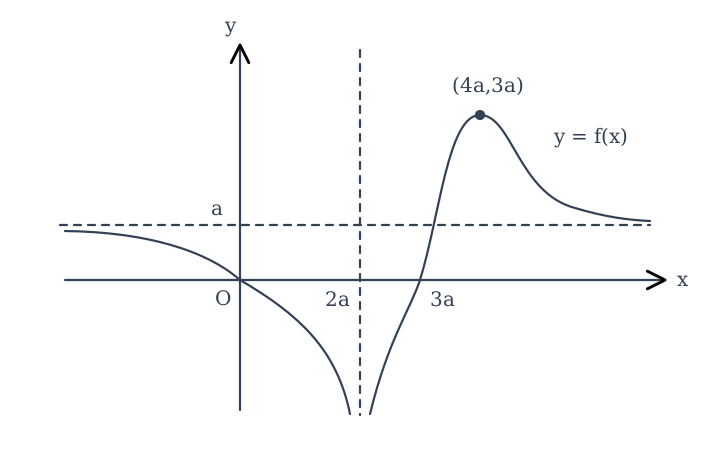
Given f: horizontal asymptote y=a and vertical asymptote x=2a. The decreasing left branch crosses the origin and tends to negative infinity at 2a from the left. The right branch rises from negative infinity, crosses at 3a, reaches the maximum (4a,3a), then decreases towards y=a from above.

[2007/MJC/I/9]

CJC · Discussion · Question 2

Track the sign of the tangent slope, then locate the zero gradient at the maximum.

Read the worked solution