Porisma

Worked solution

Differentiate the shape with a sloping asymptote

The diagram shows the graph of y=g(x)y=g(x). Its intersections with the axes are (0,1)(0,1), (1,0)(1,0) and (3,0)(3,0). The asymptotes are x=2x=2 and y=−x+2y=-x+2.

Sketch the graph of y=g′(x)y=g^{\prime}(x), making clear the main relevant features.

Expand diagram

Use the scrollbars or arrow keys to inspect details.
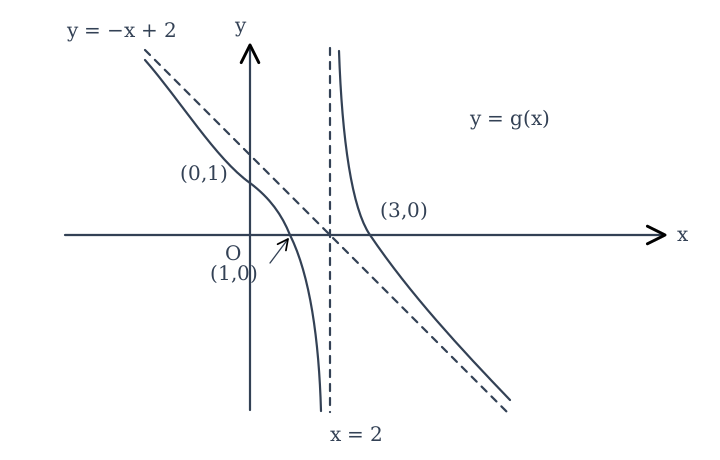
Given decreasing g: intercepts (0,1), (1,0), and (3,0), vertical asymptote x=2 and sloping asymptote y=−x+2. The left branch falls to negative infinity at 2 from the left; the right branch falls from positive infinity at 2 from the right.

[2013/VJC/Promo/10(ii)]

CJC · Discussion · Question 3

Answer

The source sketch of g′g^{\prime} has asymptotes x=2x=2 and y=−1y=-1, with both branches below −1-1 and tending to −∞-\infty at x=2x=2.

Read the decreasing branches

Both branches of the supplied graph decrease throughout their domains. The gradient graph therefore lies below the x-axis, with no stationary-point zeros. As drawn, the slopes become arbitrarily negative on both sides of x=2x=2.

How did this part go?

Retain the printed derivative asymptotes

The printed solution has vertical asymptote x=2x=2 and horizontal asymptote y=−1y=-1. Both branches lie below y=−1y=-1, fall towards −∞-\infty near x=2x=2, and approach −1-1 from below as x→±∞x\to\pm\infty.

The limiting slope −1-1 matches the smooth approach shown to the oblique asymptote y=−x+2y=-x+2. The intercepts (0,1)(0,1), (1,0)(1,0) and (3,0)(3,0) locate the original curve; none requires an intercept of g′g^{\prime}. No derivative intercept or exact formula is specified by the source.

How did this part go?

Compare your sketch

Expand diagram

Use the scrollbars or arrow keys to inspect details.
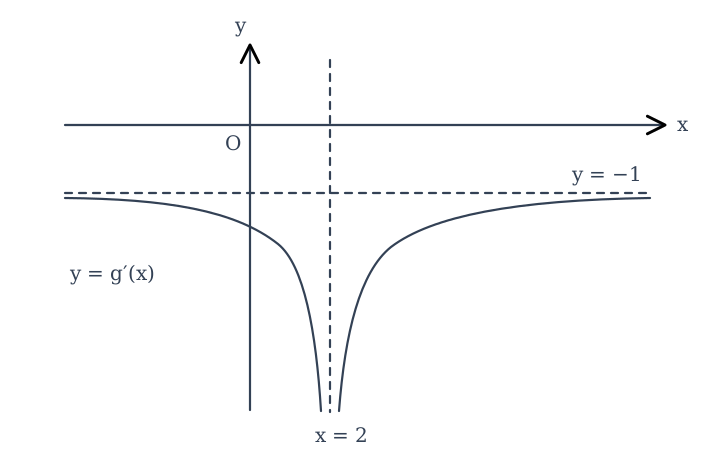
Derivative sketch with vertical asymptote x=2 and horizontal asymptote y=−1. Both branches are below −1 and tend to negative infinity near x=2, approaching −1 from below at the far left and far right.

Common mistakes

Do not use the original curve’s zeros as zeros of its derivative.

Read the hint