Porisma

A hint to get started

Differentiate the shape with a sloping asymptote

The diagram shows the graph of y=g(x)y=g(x). Its intersections with the axes are (0,1)(0,1), (1,0)(1,0) and (3,0)(3,0). The asymptotes are x=2x=2 and y=−x+2y=-x+2.

Sketch the graph of y=g′(x)y=g^{\prime}(x), making clear the main relevant features.

Expand diagram

Use the scrollbars or arrow keys to inspect details.
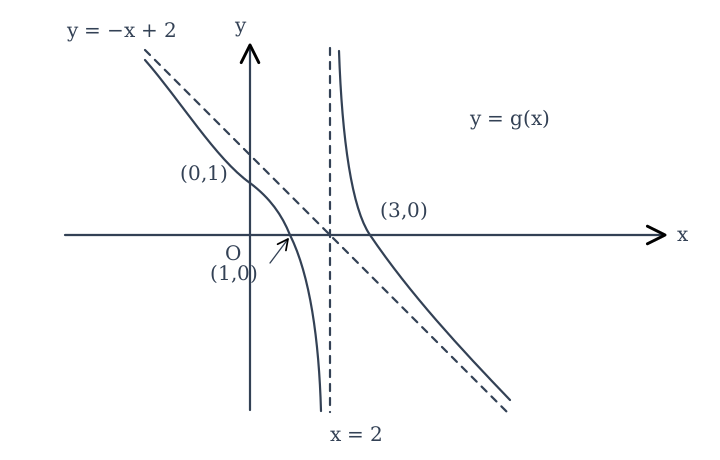
Given decreasing g: intercepts (0,1), (1,0), and (3,0), vertical asymptote x=2 and sloping asymptote y=−x+2. The left branch falls to negative infinity at 2 from the left; the right branch falls from positive infinity at 2 from the right.

[2013/VJC/Promo/10(ii)]

CJC · Discussion · Question 3

Read gradients rather than heights; the sloping asymptote suggests the limiting slope in this smooth sketch.

Read the worked solution