Porisma

A hint to get started

Recover a decreasing function from its modulus

The diagram shows the graph of y=∣h(x)∣y=|h(x)|. Given that h′(x)<0h^{\prime}(x)<0 for x∈Rx\in\mathbb{R}, x≠0x\ne0, sketch the graph of y=h(x)y=h(x).

The supplied modulus graph has vertical asymptote x=0x=0, horizontal asymptote y=ay=a, and a zero at x=b>0x=b>0.

Expand diagram

Use the scrollbars or arrow keys to inspect details.
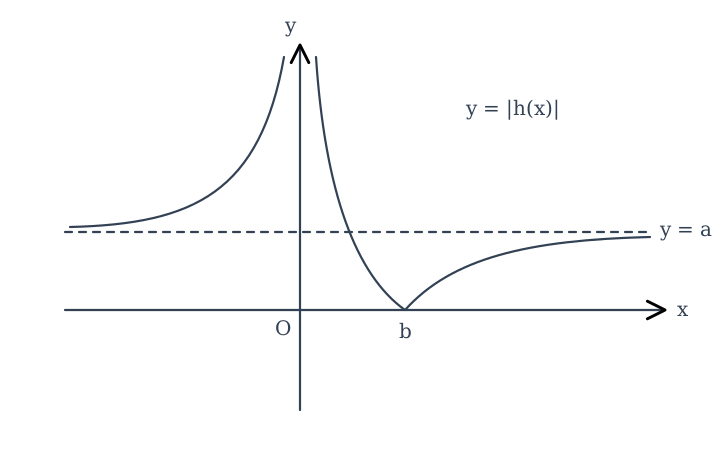
Given modulus graph |h(x)|: a positive left branch increases from horizontal asymptote y=a towards infinity at x=0. On the right, the graph falls from infinity to zero at x=b, then rises towards y=a from below. The point b is positive.

[2010/IJC/Promo/6b]

CJC · Discussion · Question 4

Choose the sign separately on each interval so that h always decreases.

Read the worked solution