Porisma

A hint to get started

Read stationary points and concavity from a gradient graph

The diagram shows y=f′(x)y=f^{\prime}(x). The curve cuts the x-axis at (a,0)(a,0) and (−a,0)(-a,0), has a stationary point at (0,b)(0,b), and has asymptote y=ky=k.

(i) State the x-coordinates of the stationary points of y=f(x)y=f(x) and determine the nature of each.

(ii) State the ranges of xx for which y=f(x)y=f(x) is (a) strictly increasing, (b) concave downwards.

Expand diagram

Use the scrollbars or arrow keys to inspect details.
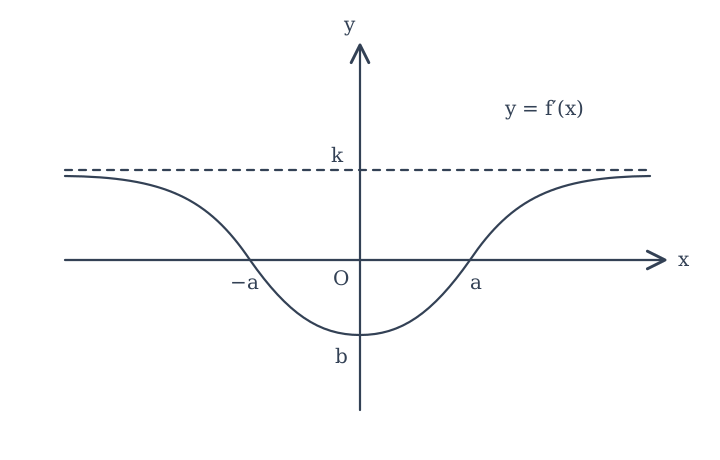
Given gradient graph f′: horizontal asymptote y=k above the x-axis, zeros at −a and a, and minimum (0,b) below the x-axis. The graph decreases for x<0 and increases for x>0, with positive tails and negative values between the zeros.

[2008/IJC/Promo/6]

CJC · Discussion · Question 5

For concavity, read whether the derivative graph rises or falls.

Read the worked solution