Porisma

Worked solution

Differentiate a triangle constrained to fixed area

The right-angled triangle ABCABC has AB=cAB=c cm, BC=aBC=a cm and AC=bAC=b cm, with right angle at CC and fixed area 100 cm2100\text{ cm}^2.

Express bb in terms of aa. Given that BCBC increases at 3 cm s−13\text{ cm s}^{-1}, find the rate of change of cc when a=20a=20.

Expand diagram

Use the scrollbars or arrow keys to inspect details.
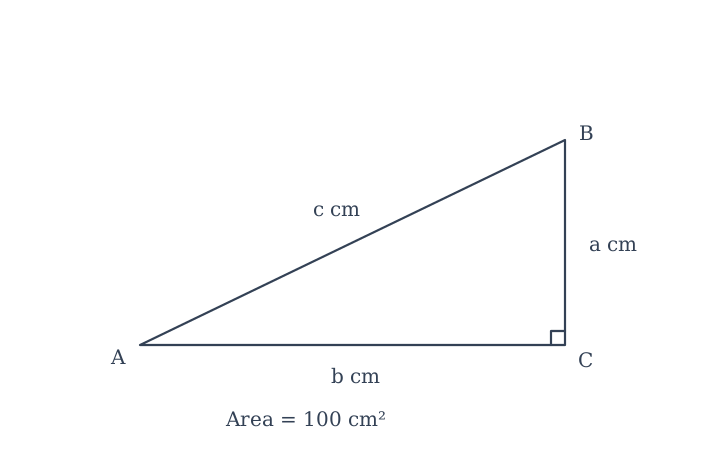
Right-angled triangle ABC with A at the left, C at the lower right and B above C. The horizontal leg AC is b cm, vertical leg BC is a cm and hypotenuse AB is c cm; angle C is a right angle.

[2018/VJC/I/10(b)]

CJC · Discussion · Question 10

Answer

b=200/ab=200/a; dc/dt=9/(25) cm s−1≈2.01 cm s−1dc/dt=9/(2\sqrt5)\text{ cm s}^{-1}\approx2.01\text{ cm s}^{-1}.

Eliminate the other changing side

ab/2=100ab/2=100 gives b=200/ab=200/a, with a>0a>0. Thus c2=a2+2002/a2c^2=a^2+200^2/a^2. When a=20a=20, b=10b=10 and c=500=105c=\sqrt{500}=10\sqrt5.

How did this part go?

Method 1: differentiate implicitly with respect to time

Differentiate the fixed-area relation after substitution:

2cdcdt=(2a−2(200)2a3)dadt.\begin{aligned}&2c\frac{dc}{dt}\\ & =\left(2a-\frac{2(200)^2}{a^3}\right)\frac{da}{dt}.\end{aligned}

At a=20a=20 and da/dt=3da/dt=3, the right-hand side is (40−10)3=90(40-10)3=90. Hence dc/dt=90/(205)=9/(25) cm s−1≈2.01 cm s−1dc/dt=90/(20\sqrt5)=9/(2\sqrt5)\text{ cm s}^{-1}\approx2.01\text{ cm s}^{-1}, so the hypotenuse is increasing.

How did this part go?

Method 2: differentiate c with respect to a

With c=(a2+2002/a2)1/2c=(a^2+200^2/a^2)^{1/2},

dcda=12(a2+2002a2)−1/2(2a−2(200)2a3).\begin{aligned}&\frac{dc}{da}\\ & =\frac12\left(a^2+\frac{200^2}{a^2}\right)^{-1/2}\left(2a-\frac{2(200)^2}{a^3}\right).\end{aligned}

Use dc/dt=(dc/da)(da/dt)dc/dt=(dc/da)(da/dt) and substitute a=20a=20 to obtain the same 9/(25) cm s−19/(2\sqrt5)\text{ cm s}^{-1}, or the printed 2.01 cm s−12.01\text{ cm s}^{-1}.

How did this part go?

Common mistakes

The other perpendicular side changes too; it is not a constant.

Read the hint