Porisma
All chapter practice

Applications of differentiation

Practice section 5 of 8

Questions 25–30 in this collection

Practice questions

Discussion practice · 1 of 6

Recover a function from its gradient and one value

The diagram shows y=f′(x)y=f^{\prime}(x), passing through the origin with turning points (−3,0)(-3,0) and (−1.5,−1)(-1.5,-1). The x-axis and x=1x=1 are its two asymptotes.

(i) Find the range of xx for which y=f(x)y=f(x) is strictly increasing and concave downwards.

(ii) State the x-coordinates and natures of all stationary points of y=f(x)y=f(x).

(iii) Given f(0)=1f(0)=1, sketch y=f(x)y=f(x) for x<1x<1, clearly indicating all stationary points, asymptotes and intersections with the axes.

Expand diagram

Use the scrollbars or arrow keys to inspect details.
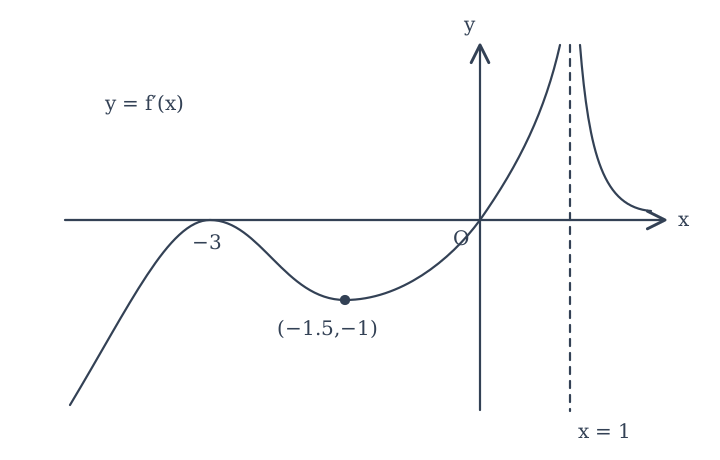
Given f′ passes through (−3,0), where it touches the x-axis from below, has minimum (−1.5,−1), then crosses the origin and rises towards positive infinity at x=1 from the left. For x>1 it falls from positive infinity towards horizontal asymptote y=0.

[2009/HCI/I/3]

CJC · Discussion · Question 6

Solution

Discussion practice · 2 of 6

Find horizontal and vertical tangents to a closed curve

The equation of a closed curve is (x+2y)2+3(x−y)2=27(x+2y)^2+3(x-y)^2=27.

(i) Show by differentiation that its gradient is dydx=y−4x7y−x\dfrac{dy}{dx}=\dfrac{y-4x}{7y-x}.

(ii) Find the equations of the tangents parallel to (a) the x-axis, (b) the y-axis.

CJC · Discussion · Question 7

Solution

Discussion practice · 3 of 6

Find a logarithmic tangent and a two-intersection slope range

The curve CC has equation 2−y=x2^{-y}=x. Its point AA has x-coordinate a>0a>0. Show that dy/dx=−1/(aln⁡2)dy/dx=-1/(a\ln2) at AA, and find the equation of the tangent there.

Hence find the tangent to CC that passes through the origin. The line y=mxy=mx intersects CC at two distinct points. Write down the range of mm.

[2008/RJC/I/11(a)]

CJC · Discussion · Question 8

Solution

Discussion practice · 4 of 6

Use implicit tangents and a normal to bound an area

The curve has equation y2−xy=−1y^2-xy=-1.

(i) Find all tangent equations parallel to the y-axis.

(ii) State and justify whether the curve has any stationary points.

(iii) Find the area bounded by the axes and the normal at the point where y=2y=2.

[2013/YJC/I/7]

CJC · Discussion · Question 9

Solution

Discussion practice · 5 of 6

Differentiate a triangle constrained to fixed area

The right-angled triangle ABCABC has AB=cAB=c cm, BC=aBC=a cm and AC=bAC=b cm, with right angle at CC and fixed area 100 cm2100\text{ cm}^2.

Express bb in terms of aa. Given that BCBC increases at 3 cm s−13\text{ cm s}^{-1}, find the rate of change of cc when a=20a=20.

Expand diagram

Use the scrollbars or arrow keys to inspect details.
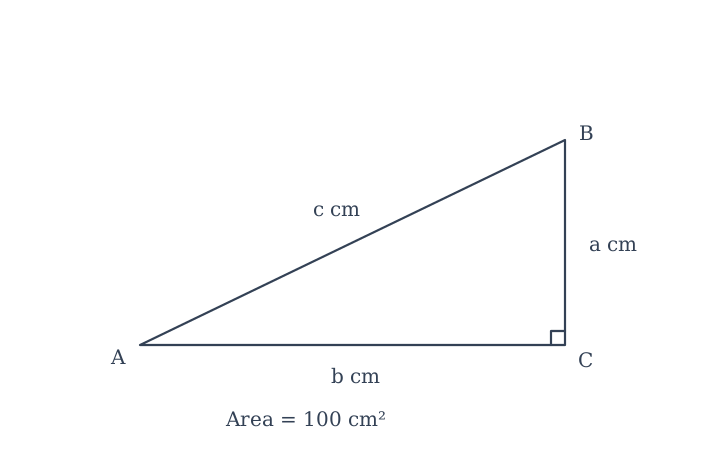
Right-angled triangle ABC with A at the left, C at the lower right and B above C. The horizontal leg AC is b cm, vertical leg BC is a cm and hypotenuse AB is c cm; angle C is a right angle.

[2018/VJC/I/10(b)]

CJC · Discussion · Question 10

Solution

Discussion practice · 6 of 6

Optimise a rectangle inside a semicircle

The diagram shows rectangle PQRSPQRS inscribed in a semicircle of radius 1010 cm, with P,QP,Q on its diameter and S,RS,R on its arc. Given PQ=xPQ=x cm, find the perimeter pp cm in terms of xx.

Show that its area is A=x2400−x2 cm2A=\dfrac{x}{2}\sqrt{400-x^2}\text{ cm}^2. Find the exact value of pp when AA has its stationary value.

Expand diagram

Use the scrollbars or arrow keys to inspect details.
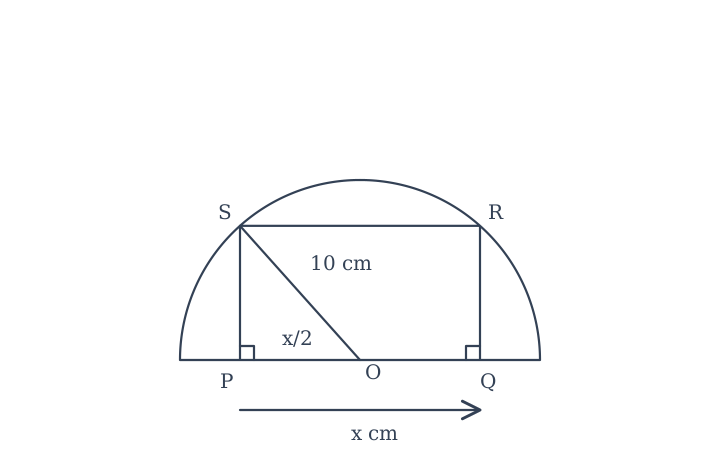
Rectangle PQRS inside a semicircle of radius 10 cm. P and Q lie on the horizontal diameter; S and R are the upper left and upper right arc points. PQ has length x. A radius from the centre to S and a half-width x/2 form the right triangle used to find the height.

[2008/JJC/Promo/12]

CJC · Discussion · Question 11

Solution

Back to all practice questions