Porisma

Worked solution

Optimise a rectangle inside a semicircle

The diagram shows rectangle PQRSPQRS inscribed in a semicircle of radius 1010 cm, with P,QP,Q on its diameter and S,RS,R on its arc. Given PQ=xPQ=x cm, find the perimeter pp cm in terms of xx.

Show that its area is A=x2400−x2 cm2A=\dfrac{x}{2}\sqrt{400-x^2}\text{ cm}^2. Find the exact value of pp when AA has its stationary value.

Expand diagram

Use the scrollbars or arrow keys to inspect details.
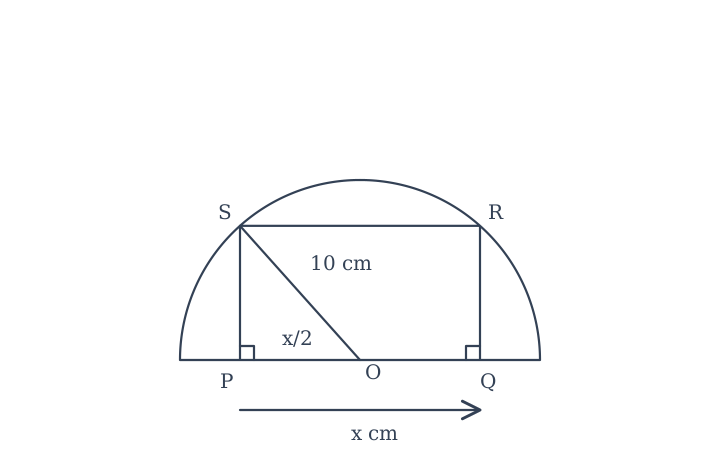
Rectangle PQRS inside a semicircle of radius 10 cm. P and Q lie on the horizontal diameter; S and R are the upper left and upper right arc points. PQ has length x. A radius from the centre to S and a half-width x/2 form the right triangle used to find the height.

[2008/JJC/Promo/12]

CJC · Discussion · Question 11

Answer

p=400−x2+2xp=\sqrt{400-x^2}+2x cm; A=x400−x2/2A=x\sqrt{400-x^2}/2; at stationary area, x=102x=10\sqrt2 cm and p=302p=30\sqrt2 cm.

Use the half-width in the radius triangle

By symmetry the half-width is x/2x/2, so Pythagoras gives PS=100−(x/2)2=12400−x2PS=\sqrt{100-(x/2)^2}=\tfrac12\sqrt{400-x^2}. A nondegenerate rectangle has 0<x<200<x<20. Thus p=2PS+2x=400−x2+2xp=2PS+2x=\sqrt{400-x^2}+2x cm.

How did this part go?

Form and differentiate the area

The area is A=x PS=x2400−x2A=x\,PS=\tfrac{x}{2}\sqrt{400-x^2}, as required. By the product rule,

dAdx=−x22400−x2+12400−x2=200−x2400−x2.\begin{aligned}&\frac{dA}{dx}\\ & =-\frac{x^2}{2\sqrt{400-x^2}}\\ &{}+\frac12\sqrt{400-x^2}\\ & =\frac{200-x^2}{\sqrt{400-x^2}}.\end{aligned}

How did this part go?

Substitute the admissible stationary width into p

dA/dx=0dA/dx=0 gives x2=200x^2=200. Reject the negative root because x>0x>0, leaving x=102x=10\sqrt2. Hence p=400−200+2(102)=302p=\sqrt{400-200}+2(10\sqrt2)=30\sqrt2 cm. This is the perimeter when the area is stationary, rather than the perimeter’s own stationary value.

How did this part go?

Common mistakes

The target is the perimeter at stationary area, not the maximum perimeter.

Read the hint