Porisma

Worked solution

Minimise the cone circumscribed about a sphere

A cone of radius rr and height hh has volume 13πr2h\tfrac13\pi r^2h. A sphere of fixed radius aa and centre OO is inscribed in a right cone, touching its base and curved surface, as shown.

(i) Show that r2=a2hh−2ar^2=\dfrac{a^2h}{h-2a}. marks

(ii) Use differentiation to find the minimum volume of the cone in terms of aa, proving it is a minimum. marks

Expand diagram

Use the scrollbars or arrow keys to inspect details.
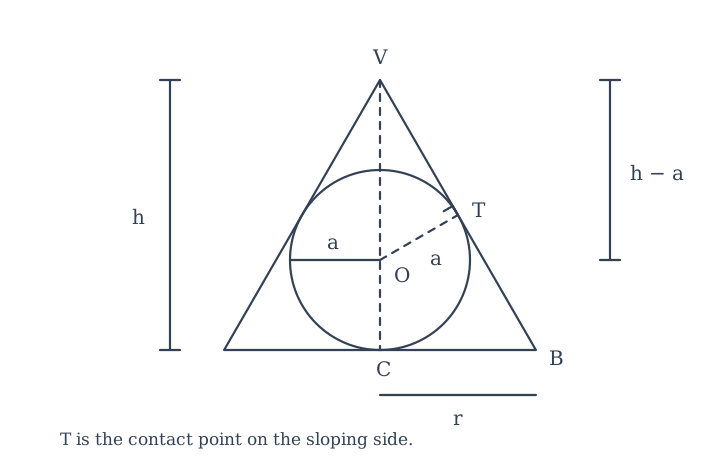
Axial section of a cone containing an inscribed sphere. The cone has apex V, height h and base radius r; the sphere centre O is a above base centre C and its radius is a. The perpendicular OT to the right sloping side meets it at T; VO=h−a and VT is the square root of h squared minus 2ah.

[2021/ACJC/I/5]

CJC · Discussion · Question 12

Answer

r2=a2h/(h−2a)r^2=a^2h/(h-2a) for h>2ah>2a; minimum volume 8πa3/38\pi a^3/3, attained at h=4ah=4a.

(i) Use the source similar right triangles

Let VV be the cone apex, CC its base centre, and TT the point where the sphere touches a sloping generator in an axial section. Then VO=h−aVO=h-a and OT=aOT=a, with OT⊥VTOT\perp VT, so VT=(h−a)2−a2=h2−2ahVT=\sqrt{(h-a)^2-a^2}=\sqrt{h^2-2ah}. The similar right triangles VTOVTO and VCBVCB (where BB is a base-rim point) give VT/h=a/rVT/h=a/r. Squaring,

h2−2ahh2=a2r2,h−2ah=a2r2,r2=a2hh−2a.\frac{h^2-2ah}{h^2}=\frac{a^2}{r^2},\qquad\frac{h-2a}{h}=\frac{a^2}{r^2},\qquad r^2=\frac{a^2h}{h-2a}.

The physical domain is a>0a>0, h>2ah>2a. Merely requiring h>0h>0 would allow impossible cones.

How did this part go?

(ii) Form the volume and find its stationary height

Substitute the relation into the cone volume:

V=πa23h2h−2a,dVdh=πa232h(h−2a)−h2(h−2a)2=πa2h(h−4a)3(h−2a)2.V=\frac{\pi a^2}{3}\frac{h^2}{h-2a},\qquad \frac{dV}{dh}=\frac{\pi a^2}{3}\frac{2h(h-2a)-h^2}{(h-2a)^2}=\frac{\pi a^2h(h-4a)}{3(h-2a)^2}.

The algebraic roots are h=0,4ah=0,4a; reject 00 as outside the physical domain. Thus the only admissible stationary height is h=4ah=4a.

How did this part go?

Method 1: prove a minimum by the first derivative

For h>2ah>2a, the factor πa2h/[3(h−2a)2]\pi a^2h/[3(h-2a)^2] is positive, so dV/dhdV/dh has the sign of h−4ah-4a. The source sign chart is negative–zero–positive across 4a4a: the volume falls on (2a,4a)(2a,4a) and rises on (4a,∞)(4a,\infty). This proves a minimum throughout the feasible domain.

How did this part go?

Method 2: prove a minimum by the second derivative

The quotient rule gives

d2Vdh2=πa23(h−2a)2(2h−4a)−2h(h−4a)(h−2a)(h−2a)4=8πa43(h−2a)3.\begin{aligned}&\frac{d^2V}{dh^2}\\ & =\frac{\pi a^2}{3}\frac{(h-2a)^2(2h-4a)-2h(h-4a)(h-2a)}{(h-2a)^4}\\ & =\frac{8\pi a^4}{3(h-2a)^3}.\end{aligned}

At h=4ah=4a, this is πa/3>0\pi a/3>0. Substituting into the volume gives Vmin⁡=πa23(4a)2/(4a−2a)=83πa3V_{\min}=\tfrac{\pi a^2}{3}(4a)^2/(4a-2a)=\tfrac83\pi a^3. Both printed minimum tests are retained.

How did this part go?

Common mistakes

The sphere must fit: the cone height exceeds 2a, and the zero-height algebraic root is inadmissible.

Read the hint