Porisma
All chapter practice

Applications of differentiation

Practice section 6 of 8

Questions 31–36 in this collection

Practice questions

Discussion practice · 1 of 6

Minimise the cone circumscribed about a sphere

A cone of radius rr and height hh has volume 13πr2h\tfrac13\pi r^2h. A sphere of fixed radius aa and centre OO is inscribed in a right cone, touching its base and curved surface, as shown.

(i) Show that r2=a2hh−2ar^2=\dfrac{a^2h}{h-2a}. [2]

(ii) Use differentiation to find the minimum volume of the cone in terms of aa, proving it is a minimum. [6]

Expand diagram

Use the scrollbars or arrow keys to inspect details.
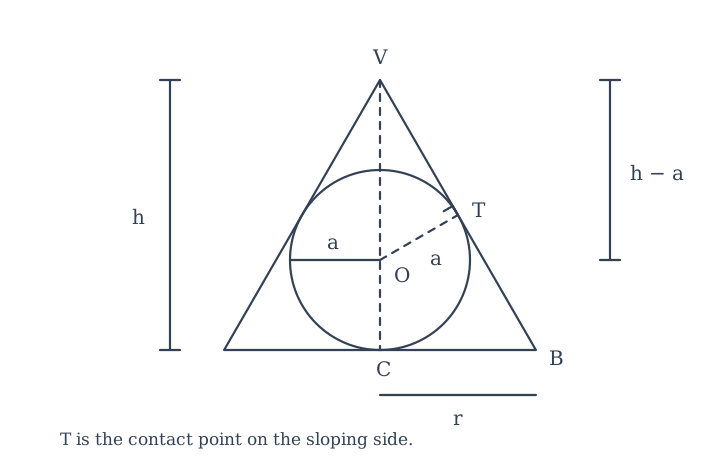
Axial section of a cone containing an inscribed sphere. The cone has apex V, height h and base radius r; the sphere centre O is a above base centre C and its radius is a. The perpendicular OT to the right sloping side meets it at T; VO=h−a and VT is the square root of h squared minus 2ah.

[2021/ACJC/I/5]

CJC · Discussion · Question 12

Solution

Discussion practice · 2 of 6

Combine a leaking cone with trapezium optimisation

(a) A factory produces disposable cups in the shape of inverted right cones of radius 44 cm and height 88 cm. For a quality check, the supervisor fills one cup completely with water. Water leaks from its vertex at a constant 1.5 cm3 s−11.5\text{ cm}^3\text{ s}^{-1}. Find the exact rate at which the water level is decreasing when its depth is 22 cm. [4]

The volume of a cone of base radius rr and height hh is 13πr2h\tfrac13\pi r^2h.

(b) Trapezium ABCDABCD has height 55 cm and DA+AB+BC=20DA+AB+BC=20 cm. Points M,NM,N are the feet of the perpendiculars from A,BA,B to DCDC. Given ∠DAM=∠CBN=θ\angle DAM=\angle CBN=\theta, where 0<θ<π/20<\theta<\pi/2:

(i) Show that its area is A=100−50sec⁡θ+25tan⁡θ cm2A=100-50\sec\theta+25\tan\theta\text{ cm}^2. [3]

(ii) Hence use differentiation to find its maximum area in exact form. You do not need to verify that it is a maximum. [4]

Expand diagram

Use the scrollbars or arrow keys to inspect details.
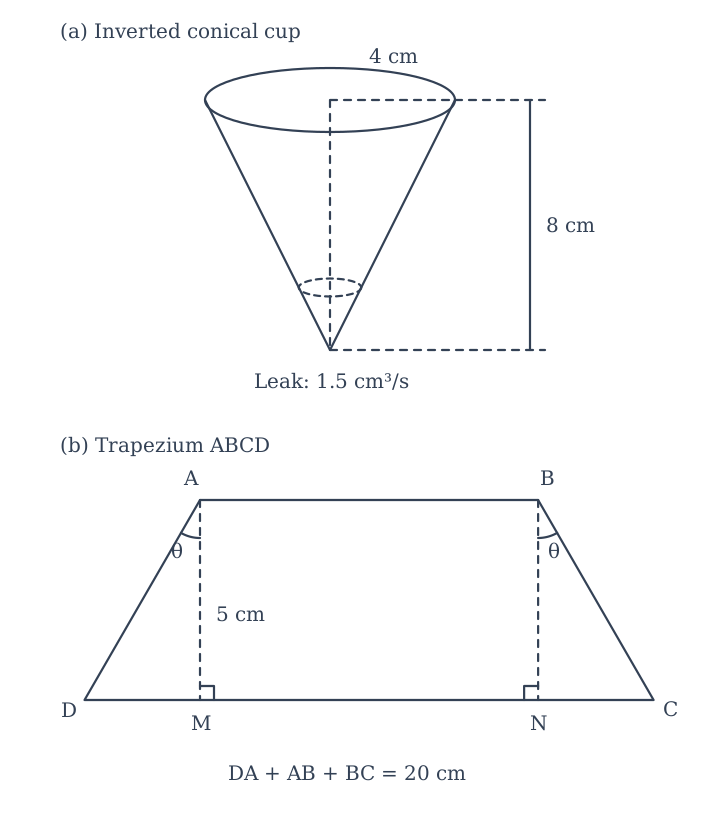
Two given diagrams. (a) An inverted conical cup with top radius 4 cm and vertical height 8 cm, with a smaller water cone inside and leakage at its bottom vertex. (b) Trapezium ABCD with top AB, longer base DC and perpendiculars AM and BN of length 5 cm. The equal angles theta lie between AD and AM at A, and between BC and BN at B. The sum DA+AB+BC is 20 cm.

[2022/TMJC/I/6]

CJC · Discussion · Question 13

Solution

Review practice · 3 of 6

Sketch a derivative across two vertical asymptotes

The diagram, not to scale, shows the graph of y=f(x)y=f(x). The vertical asymptotes are x=0x=0 and x=2x=2. Sketch the graph of y=f′(x)y=f^{\prime}(x), showing all corresponding coordinates and asymptotes where possible. [3]

Expand diagram

Use the scrollbars or arrow keys to inspect details.
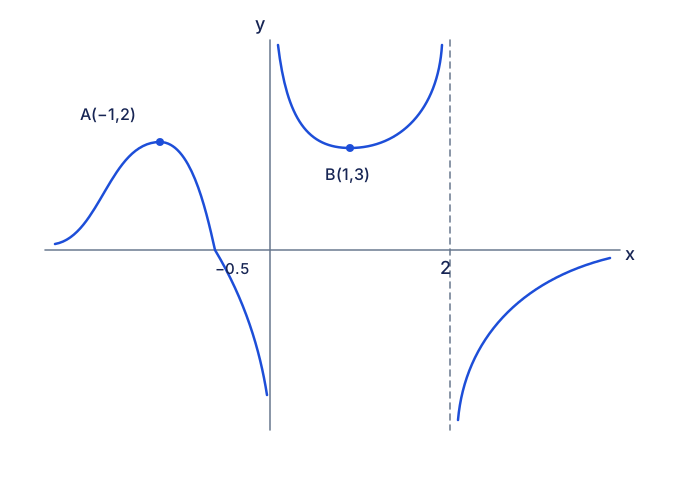
Qualitative graph, not to scale: local maximum A(-1,2) on the negative-x branch, zero at -0.5, vertical asymptote x=0; between 0 and 2 a U-shaped branch has minimum B(1,3); beyond x=2 the curve rises from negative infinity towards the x-axis. No numerical function is supplied.

[2010/SRJC/I/6(a)]

CJC · Review problems · Question 1

Solution

Review practice · 4 of 6

Sketch the gradient across a pole and a minimum

The graph of y=f(x)y=f(x) has asymptotes x=2x=2, y=−3y=-3 and minimum (−2,−5)(-2,-5), as shown. Sketch y=f′(x)y=f^{\prime}(x), clearly indicating any asymptotes, turning points and axial intercepts. [3]

The supplied graph also labels x-intercepts 1,41,4 and y-intercept −3-3.

Expand diagram

Use the scrollbars or arrow keys to inspect details.
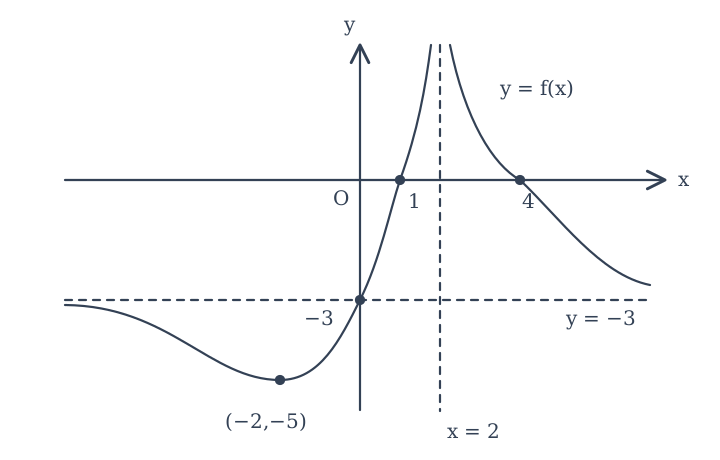
Given function with vertical asymptote x=2 and horizontal asymptote y=−3. The left branch initially falls below −3, reaches minimum (−2,−5), then rises through (0,−3) and (1,0) to positive infinity at 2 from the left. The right branch falls from positive infinity at 2 from the right, crosses (4,0), then tends to −3 from above.

[2009/CJC/Promo/10(c)]

CJC · Review problems · Question 2

Solution

Review practice · 5 of 6

Differentiate turning points and a stationary inflection

The diagram shows y=f(x)y=f(x) with a maximum at x=ax=a, minimum at x=bx=b, and stationary point of inflection at the origin. On a separate diagram draw y=f′(x)y=f^{\prime}(x). [3]

Expand diagram

Use the scrollbars or arrow keys to inspect details.
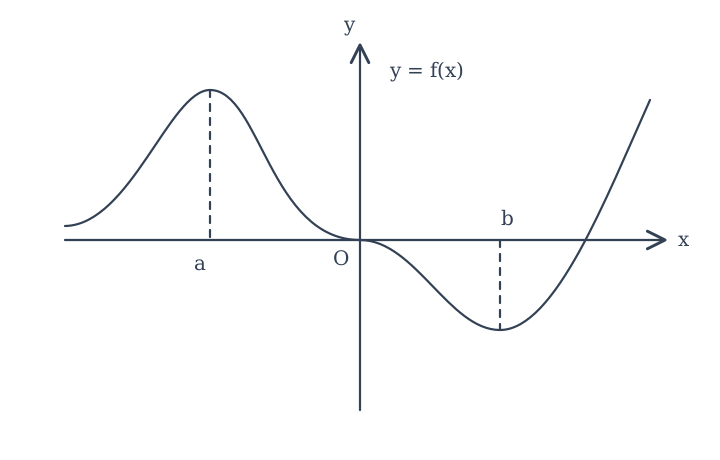
Given function rises to a maximum at negative x=a, decreases through a stationary inflection at the origin, continues to a minimum at positive x=b, then rises. The two turning-point x-values are marked a and b without numerical coordinates.

[2009/SRJC/Promo/2]

CJC · Review problems · Question 3

Solution

Review practice · 6 of 6

Read a derivative from an oblique asymptote and two extrema

The diagram shows y=f(x)y=f(x) with asymptotes x=3x=3 and y=−x+2y=-x+2, y-intercept 7/37/3, minimum (2,1)(2,1) and maximum (4,−3)(4,-3).

Sketch the curve y=f′(x)y=f^{\prime}(x). [3]

Expand diagram

Use the scrollbars or arrow keys to inspect details.
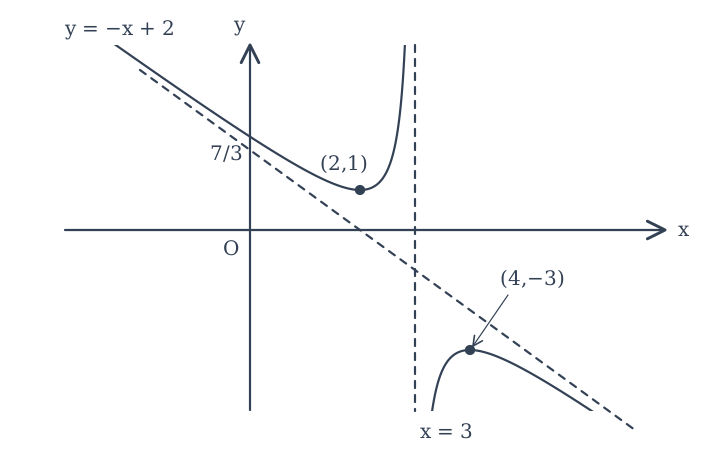
Given function with asymptotes x=3 and y=−x+2, y-intercept 7/3, minimum (2,1) on the left branch and maximum (4,−3) on the right. The left branch tends up without bound at 3 from the left; the right starts at negative infinity and rises to its maximum before falling.

[2010/VJC/Promo/6(ii)]

CJC · Review problems · Question 4

Solution

Back to all practice questions