Porisma

Worked solution

A rational function that is its own inverse

The function ff is defined by f:x↦axbx−af:x\mapsto\dfrac{ax}{bx-a} for x∈Rx\in\mathbb R, x≠abx\ne\dfrac ab, where aa and bb are non-zero constants.

(i) Find f−1(x)f^{-1}(x). Hence or otherwise find f2(x)f^2(x) and state the range of f2f^2.

(ii) The function gg is defined by g:x↦1xg:x\mapsto\dfrac1x for all real non-zero xx.

State whether the composite function fgfg exists, justifying your answer.

(iii) Solve the equation f−1(x)=xf^{-1}(x)=x.

[2009/II/3]

CJC · Functions · Discussion 4 · 2025

Answer

(i) f−1(x)=ax/(bx−a)f^{-1}(x)=ax/(bx-a); f2(x)=xf^2(x)=x, domain and range R∖{a/b}\mathbb R\setminus\{a/b\}. (ii) fgfg does not exist on all of DgD_g. (iii) x=0x=0 or 2a/b2a/b.

(i)

Let y=ax/(bx−a)y=ax/(bx-a). Rearranging gives bxy−ay=axbxy-ay=ax, then x(by−a)=ayx(by-a)=ay, so x=ay/(by−a)x=ay/(by-a). Thus f−1(x)=ax/(bx−a)f^{-1}(x)=ax/(bx-a), with domain R∖{a/b}\mathbb R\setminus\{a/b\}, the same as f. Its range also excludes a/b: the equation f(x)=a/b would force a=0, contrary to the assumption. Hence f equals its inverse as a function, and f2(x)=f(f(x))=xf^2(x)=f(f(x))=x for x≠a/bx\ne a/b. The range of f² is R∖{a/b}\mathbb R\setminus\{a/b\}, not all real numbers.

How did this part go?

(ii)

Rg=R∖{0}R_g=\mathbb R\setminus\{0\}, whereas Df=R∖{a/b}D_f=\mathbb R\setminus\{a/b\}. Since a/b is nonzero, it belongs to Rg but not Df. Thus Rg⊈DfR_g\nsubseteq D_f and fg does not exist on the full given domain of g. The input b/a is the specific obstruction.

How did this part go?

(iii)

Solve ax/(bx−a)=xax/(bx-a)=x, retaining x≠a/b. Multiplying gives ax=bx2−axax=bx^2-ax, hence bx2−2ax=0bx^2-2ax=0 and x(bx−2a)=0x(bx-2a)=0. Therefore x=0x=0 or x=2a/bx=2a/b. Both are allowed because a/b≠0.

How did this part go?

Compare your sketch

Expand diagram

Use the scrollbars or arrow keys to inspect details.
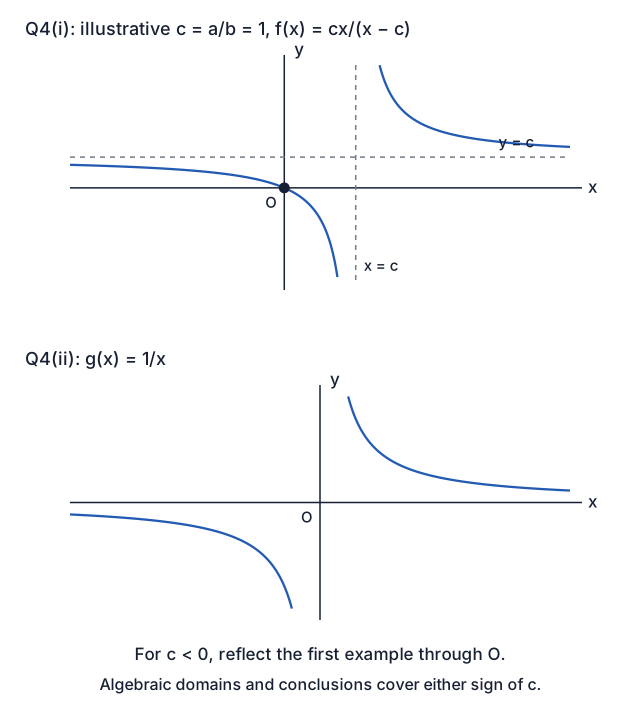
The first graph is an illustrative positive-ratio case c=a/b=1 of f(x)=cx/(x−c): it passes through O, has vertical asymptote x=c and horizontal asymptote y=c, and has two decreasing branches. Reflecting through O gives a negative-ratio case; no sign is imposed in the question. The second graph is g=1/x on nonzero inputs with axes as asymptotes. Its range contains the nonzero value c excluded from Df, so fg fails on the full domain of g.

Common mistakes

The identity composite retains the original missing input. The source sketch shows a positive a/b example, while the algebra works for either sign.

Solution notes

The printed phrase “where and b are non-zero constants” omits a. The student wording supplies the intended a and b, as required by the formula and source working. The omission is retained here as a source correction.

The source graph places a/b on the positive axes, although no sign is specified. The reconstructed positive-ratio example is explicitly illustrative; reflecting it through the origin gives the negative-ratio case. No positivity assumption is added to the problem.

Read the hint