Worked solution
A rational function that is its own inverse
The function is defined by for , , where and are non-zero constants.
(i) Find . Hence or otherwise find and state the range of .
(ii) The function is defined by for all real non-zero .
State whether the composite function exists, justifying your answer.
(iii) Solve the equation .
[2009/II/3]
CJC · Functions · Discussion 4 · 2025
Answer
(i) ; , domain and range . (ii) does not exist on all of . (iii) or .
(i)
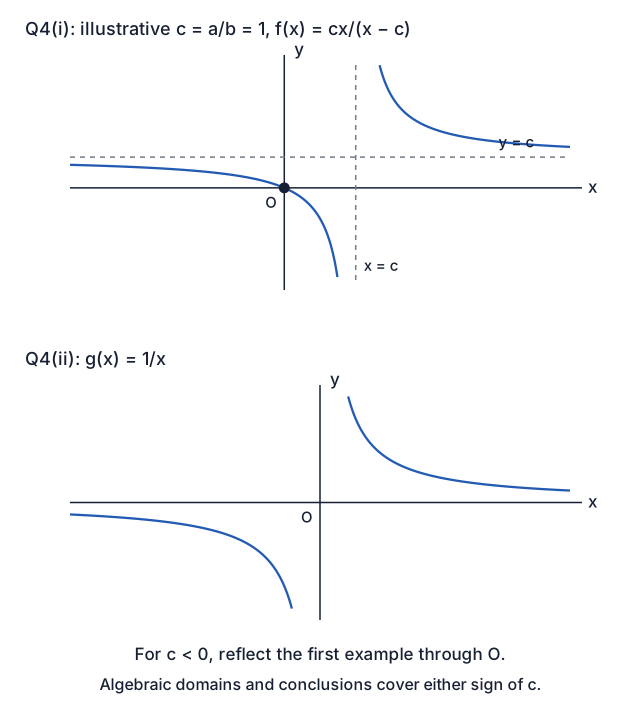
Let . Rearranging gives , then , so . Thus , with domain , the same as f. Its range also excludes a/b: the equation f(x)=a/b would force a=0, contrary to the assumption. Hence f equals its inverse as a function, and for . The range of f² is , not all real numbers.
(ii)
, whereas . Since a/b is nonzero, it belongs to Rg but not Df. Thus and fg does not exist on the full given domain of g. The input b/a is the specific obstruction.
(iii)
Solve , retaining x≠a/b. Multiplying gives , hence and . Therefore or . Both are allowed because a/b≠0.
Compare your sketch
Expand diagramFit diagram to page
Use the scrollbars or arrow keys to inspect details.
Common mistakes
The identity composite retains the original missing input. The source sketch shows a positive a/b example, while the algebra works for either sign.
Solution notes
The printed phrase “where and b are non-zero constants” omits a. The student wording supplies the intended a and b, as required by the formula and source working. The omission is retained here as a source correction.
The source graph places a/b on the positive axes, although no sign is specified. The reconstructed positive-ratio example is explicitly illustrative; reflecting it through the origin gives the negative-ratio case. No positivity assumption is added to the problem.