Worked solution
A piecewise inverse and two identity domains
The function is defined by
(i) Sketch the graph of , indicating clearly the coordinates of the axial intercepts and endpoints.
(ii) Show that has an inverse, and define it in similar form.
(iii) Find the range of values of for which .
(iv) The function is defined by , .
Find the range of .
[2020/HCI/Promo/11]
CJC · Functions · Discussion 6 · 2025
Answer
(ii) for , and for . (iii) . (iv) .
(i)
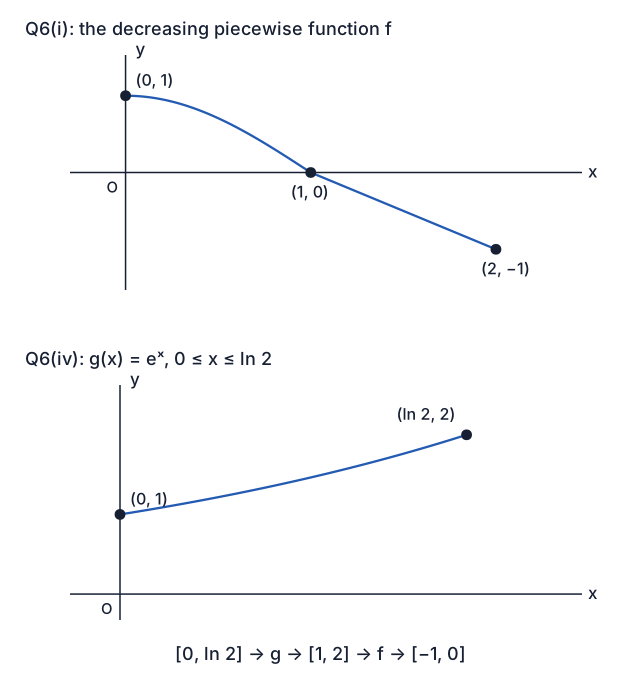
The cosine branch decreases from closed (0,1) towards (1,0). The line branch includes (1,0) and ends at closed (2,−1). Thus the y-intercept is (0,1), the x-intercept is (1,0), and both outer endpoints are included.
(ii)
Every horizontal line meets the graph at most once: f is strictly decreasing over [0,2], so it is one-to-one. On 0≤x<1, solve to obtain . On 1≤x≤2, solve y=1−x to get x=1−y. Therefore The inverse domain is [−1,1]. As the source notes, x=0 can be attached to either branch or both because both formulas give 1 there.
(iii)
Both composites have identity rule x, but and . They can be compared only on the intersection, [0,1]. Hence .
(iv)
The graph of g has closed endpoints (0,1) and (ln2,2). It maps to , where the outer f uses the linear branch 1−x. The mapping chain is . Thus .
Compare your sketch
Expand diagramFit diagram to page
Use the scrollbars or arrow keys to inspect details.
Common mistakes
Having the same identity rule does not make the two composites equal on different domains.