Worked solution
Find the reference means rejected by an upper-tail test
Clara, who has diabetes, monitors glucose levels that vary throughout the day. A sample of 75 readings at random times over a week gives , .
(i) Find the set of values for which it would be accepted that at the 10% significance level.
(ii) State, with a reason, whether that conclusion would remain valid if all 75 readings were taken during weekends.
[2006/HCI/II/22(modified)]
CJC · Discussion · Question 6
Answer
(i) Full-precision normal-approximation rejection set ; intersect with positive values only if that restriction is imposed. (ii) Weekend-only readings do not justify whole-week inference.
(i) Estimate and invert the test
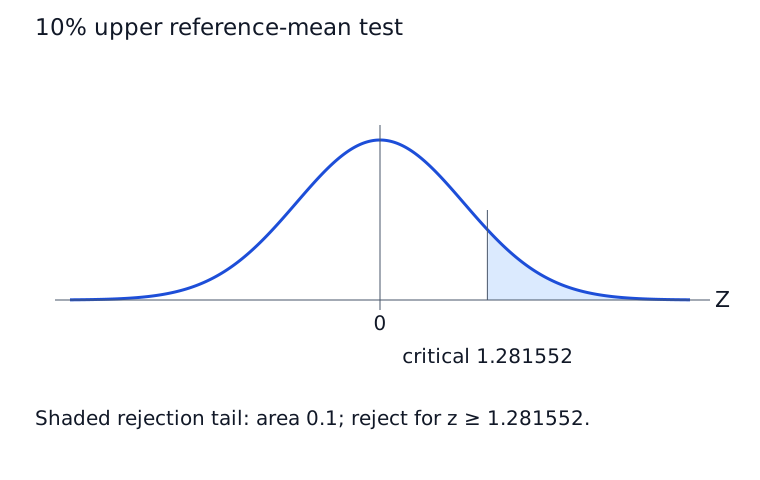
and . Test against . Using the source’s independent large-sample normal approximation, under . Reject for . Therefore This is rejection in favour of the upper alternative, not proof of it.
(i) Interpret the source’s set and rounding
The printed set is . Its positive lower bound is an extra restriction on reference means, not a consequence of the test inequality. Without that restriction, the real-valued rejection set is ; with positive reference means, intersect it with . The bound 6.42 is rounded; if reference means are explicitly restricted to a 0.01 grid, it is the largest rejecting grid value.
(ii) Coverage of the target time period
Weekend-only sampling does not cover all times during the week and need not represent the whole-week target. Randomness within weekends does not repair the missing weekday frame. The source rejects the whole-week inference for possible time-pattern bias; that does not establish any specific dietary or clinical effect. Even random times over the week need a suitable dependence model: temporal correlation can invalidate the iid standard error used here.
Compare your sketch
Expand diagramFit diagram to page
Use the scrollbars or arrow keys to inspect details.
Common mistakes
Random times do not by themselves establish independent readings.