Worked solution
Distinguish unbiased variance, estimated SD and significance
A Mathematics test is administered to a large group. For 200 recorded scores, and .
(i) Find unbiased estimates of the population mean and standard deviation.
(ii) Test at 5% whether the population mean score exceeds 50. State, with a reason, whether assumptions about the population distribution are needed.
The alternative hypothesis is accepted at significance.
(iii) Find an inequality satisfied by .
(iv) Explain “ level of significance” in this context.
[2008/JJC/II/10(modified)]
CJC · Discussion · Question 7
Answer
(i) Mean 51.45; unbiased variance 281.3643216; usual SD estimate 16.8 is not generally unbiased. (ii) Do not reject at 5% (). (iii) . (iv) Approximate conditional Type I error rate.
(i) Undo the shift; qualify the SD wording
and The usual estimated SD is . The source calls that an unbiased SD estimate, matching its question, but generally is not unbiased for population SD even when is unbiased for variance. No distribution-free correction making this square root unbiased follows from these summaries alone.
(ii) p-value, critical value and model
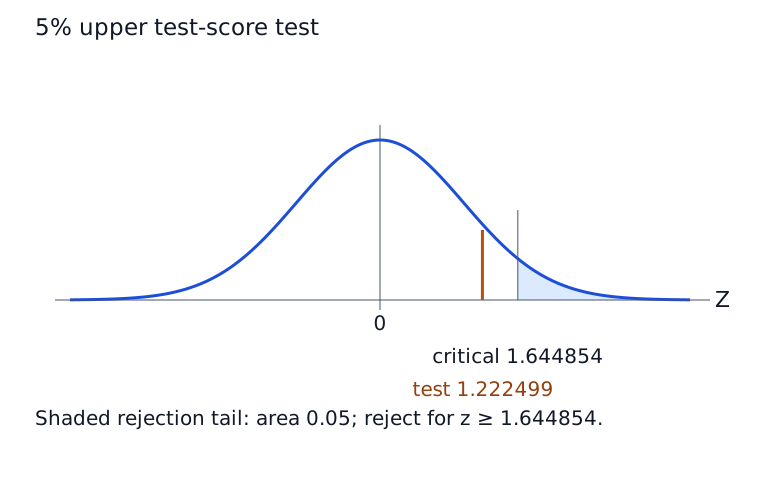
Test , . With representative independent observations and finite variance, use under by CLT, with estimated variance. No individual normality assumption is needed for that approximation; sampling and finite-moment assumptions still are. The statistic is . Its upper p-value is 0.1107595044, printed 0.111. Do not reject at 5%; there is insufficient evidence of a mean above 50. Equivalently . The source prints 1.6445 as its critical value: this is a typo, not the 5% normal quantile. Its calculator uses rounded variance 281.36 (SD 16.773789077009), giving , , with the same decision.
(iii) Keep the significance threshold unrounded
To reject under the source convention , require The printed uses a rounded p-value and is not the exact real-valued set. If significance percentages themselves are given to one decimal place,11.1% is the least rejecting grid value. “Accepting the alternative” here means rejecting the null in its favour, not establishing it as certainly true.
(iv) Conditional Type I error
When the actual population mean score is 50, this rule has approximately probability of wrongly concluding that the population mean exceeds 50, under the stated large-sample model. This is not a probability that the alternative hypothesis is true; variance estimation and CLT make the nominal error rate approximate.
Compare your sketch
Expand diagramFit diagram to page
Use the scrollbars or arrow keys to inspect details.
Common mistakes
The source’s critical 1.6445 and “unbiased SD” wording need explicit corrections. No assumption of population normality does not mean no sampling or moment assumptions.