Worked solution
Test a minimum string length and interpret a strict boundary
A company sells balls of string. A manager claims average length is at least 300 m. A random sample of 100 balls gives and .
(i) Find unbiased estimates of the population mean and variance.
(ii) Test at 5% whether the manager’s claim is valid.
The process is improved and the new population variance is known to be 12.1 m². A new random sample of 100 balls has mean m. A test at 10% indicates that the manager’s claim is valid for this process.
(iii) Find the least possible , giving your answer to 2 decimal places.
CJC · Discussion · Question 8
Answer
(i) Mean 299.4 m; variance 1204/99≈12.2 m². (ii) Reject at 5% (). (iii) ; no least real value, or minimum 299.56 m if k is restricted to two-decimal increments.
(i) Shifted estimates
m and The source truncates this to 12.161 before testing; retain the full estimate.
(ii) Challenge the “at least” claim at its boundary
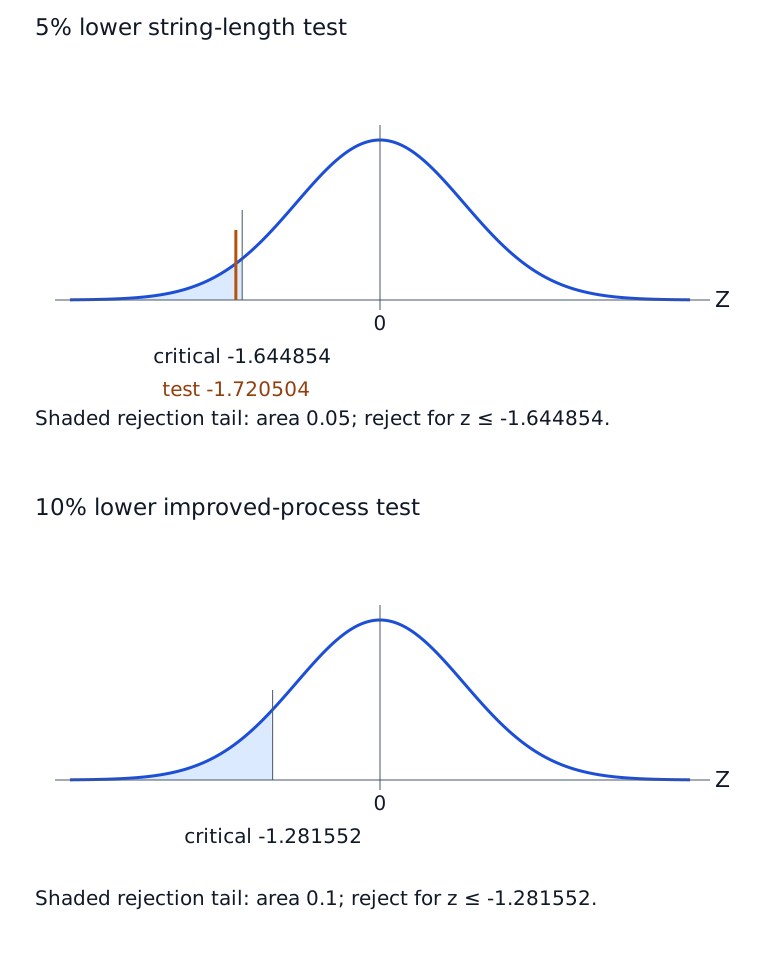
Use versus , with 300 the boundary of the composite claim . For independent large-sample observations, under the boundary null. Then and lower-tail . Reject: sufficient evidence at 5% that mean length is below 300 m. Equivalently . The source Z-Test screen enters SD 3.4872625367185 from truncated variance 12.161, mean 299.4,n 100 and alternative <, giving , ; the conclusion agrees.
(iii) Failure to reject is not verification of the claim
For the improved process, use the known new variance 12.1, not the old estimate. Under the boundary null, by CLT; the individual population is not stated normal. The source interprets “claim is valid” as do not reject the lower-tail null at 10%. Since rejection includes , non-rejection requires , or . Thus This is only insufficient evidence against the claim, not proof that .
(iii) A least value requires a precision convention
Over real-valued , this strict set has no least member; its infimum is 299.554211592532…. The source prints after rounding, which is not the exact set:299.551 would satisfy that printed inequality but fail the test condition. If the sample mean itself is required to lie on a 0.01 m grid, its least admissible value is 299.56 m. Rounding the infimum to 299.55 is not the same as a feasible minimum.
Compare your sketch
Expand diagramFit diagram to page
Use the scrollbars or arrow keys to inspect details.
Common mistakes
Not rejecting H 0 does not prove the manager’s claim. The improved-process variance is known 12.1, and the strict non-rejection boundary cannot be replaced by a rounded ≥ bound.