Porisma

Worked solution

Sketch a cycloid and locate a normal intercept

Curve CC has x=θ−sin⁡θx=\theta-\sin\theta, y=1−cos⁡θy=1-\cos\theta, 0≤θ≤2π0\le\theta\le2\pi.

(i) Show that dy/dx=cot⁡(θ/2)dy/dx=\cot(\theta/2) and find the gradient at θ=π\theta=\pi. Describe the tangents as θ→0\theta\to0 and θ→2π\theta\to2\pi.

(ii) Sketch CC, clearly showing its features at θ=0,π,2π\theta=0,\pi,2\pi.

(iii) For PP with parameter pp, 0<p<π/20<p<\pi/2, show that the normal at PP crosses the x-axis at (p,0)(p,0).

[2012/I/11(modified)]

CJC · Discussion · Question 8

Answer

dy/dx=cot⁡(θ/2)dy/dx=\cot(\theta/2); gradient 00 at π\pi, vertical endpoint tangents; normal intercept (p,0)(p,0).

(i) Simplify the gradient with half-angle identities

dx/dθ=1−cos⁡θdx/d\theta=1-\cos\theta and dy/dθ=sin⁡θdy/d\theta=\sin\theta. In the interior, dy/dx=sin⁡θ/(1−cos⁡θ)=2sin⁡(θ/2)cos⁡(θ/2)/(2sin⁡2(θ/2))=cot⁡(θ/2)dy/dx=\sin\theta/(1-\cos\theta)=2\sin(\theta/2)\cos(\theta/2)/(2\sin^2(\theta/2))=\cot(\theta/2). At θ=π\theta=\pi the gradient is 00. As θ→0+\theta\to0^+ it tends to +∞+\infty, and as θ→2π−\theta\to2\pi^- it tends to −∞-\infty. Both endpoint tangents are vertical, namely x=0x=0 and x=2πx=2\pi.

How did this part go?

(ii) Mark the endpoint and maximum features

The curve is a single cycloid arch from (0,0)(0,0) to (2π,0)(2\pi,0), with a maximum at (π,2)(\pi,2). It increases before θ=π\theta=\pi and decreases afterwards, has a horizontal tangent at the maximum and vertical limiting tangents at the endpoints. Since dx/dθ>0dx/d\theta>0 for 0<θ<2π0<\theta<2\pi, it runs left to right.

How did this part go?

(iii) Write the normal and set y = 0

P=(p−sin⁡p,1−cos⁡p)P=(p-\sin p,1-\cos p) and the normal gradient is −tan⁡(p/2)-\tan(p/2). Thus y−(1−cos⁡p)=−tan⁡(p/2)[x−(p−sin⁡p)]y-(1-\cos p)=-\tan(p/2)[x-(p-\sin p)]. At y=0y=0, 1−cos⁡p=tan⁡(p/2)(x−p+sin⁡p)1-\cos p=\tan(p/2)(x-p+\sin p). Using 1−cos⁡p=2sin⁡2(p/2)1-\cos p=2\sin^2(p/2) and tan⁡(p/2)=sin⁡(p/2)/cos⁡(p/2)\tan(p/2)=\sin(p/2)/\cos(p/2), obtain sin⁡p=x−p+sin⁡p\sin p=x-p+\sin p, so x=px=p. Hence the intercept is (p,0)(p,0).

How did this part go?

Compare your sketch

Expand diagram

Use the scrollbars or arrow keys to inspect details.
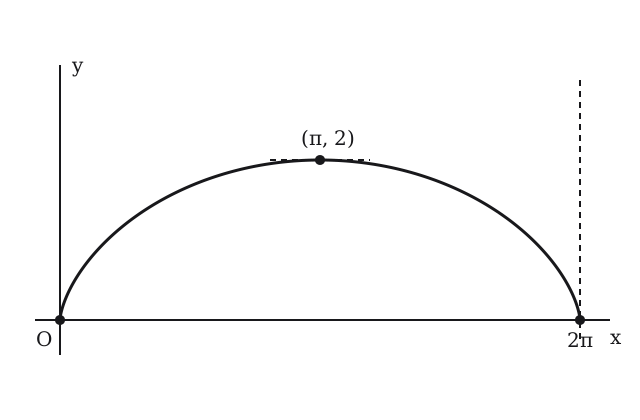
A cycloid arch from (0,0) to (2 pi,0), with maximum (pi,2), a horizontal tangent at the maximum, and vertical endpoint tangents x=0 and x=2 pi. The arch increases on the left and decreases on the right.

Common mistakes

At the right endpoint the gradient tends to negative infinity, although the tangent is still vertical.

Read the hint