Worked solution
Two throws: ordered outcomes and conditioning
In a game, an ordinary fair die is thrown twice and the number that appears on each throw is noted. Find the probability that
(i) both numbers are ‘6’,
(ii) neither number is a ‘5’,
(iii) one number is ‘6’ and the other is ‘5’,
(iv) the sum of the numbers is 6,
(v) the first number is less than the second given that the sum of the two numbers is 6.
CJC · Discussion · Question 1
Answer
(i) ; (ii) ; (iii) ; (iv) ; (v) .
Use an ordered sample space
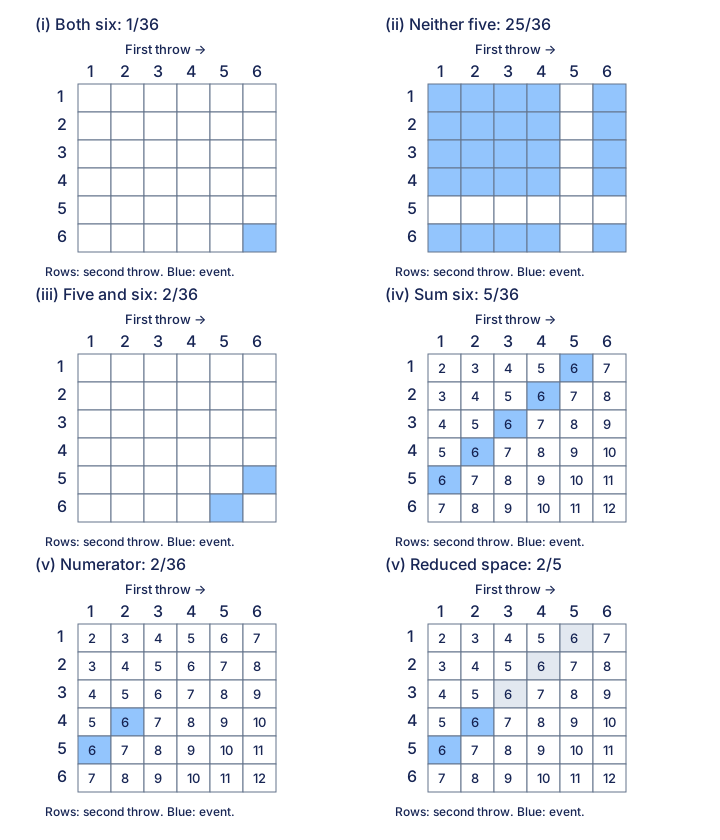
The first throw labels columns and the second labels rows. For independent throws all 36 ordered pairs are equally likely. The full sum table is:
| Second / first | 1 | 2 | 3 | 4 | 5 | 6 |
|---|---|---|---|---|---|---|
| 1 | 2 | 3 | 4 | 5 | 6 | 7 |
| 2 | 3 | 4 | 5 | 6 | 7 | 8 |
| 3 | 4 | 5 | 6 | 7 | 8 | 9 |
| 4 | 5 | 6 | 7 | 8 | 9 | 10 |
| 5 | 6 | 7 | 8 | 9 | 10 | 11 |
| 6 | 7 | 8 | 9 | 10 | 11 | 12 |
(i) Both six
Method 1 counts the single cell : . Method 2 multiplies independent probabilities: .
(ii) Neither five
Method 1 excludes the fifth row and column, leaving 25 cells. Method 2 gives .
(iii) Five and six in either order
Method 1 counts and : . Method 2 counts one specified order, then multiplies by : .
(iv) Sum six
The five pairs are , so the probability is .
(v) Method 1: conditional probability
The pairs with sum six and first throw smaller are . Thus
(v) Method 2: reduced sample space
Restrict to the five equally likely sum-six outcomes. Exactly two satisfy first<second, giving . The six reconstructed grid panels retain both conditional methods and the source orientation.
Compare your sketch
Expand diagramFit diagram to page
Use the scrollbars or arrow keys to inspect details.
Common mistakes
After conditioning on a sum of six, divide by five eligible outcomes, not by 36.
Solution notes
All five asks, both printed methods where supplied, full sum table and six shaded-grid relationships retained. Independence is the source model for successive fair throws.