Worked solution
Recover a marginal probability from a conditional one
Events A and B satisfy , and . Find
(i) ,
(ii) ,
(iii) ,
(iv) .
State, with reasons, whether A and B are independent or mutually exclusive.
CJC · Discussion · Question 2
Answer
(i) ; (ii) ; (iii) ; (iv) . Neither independent nor mutually exclusive.
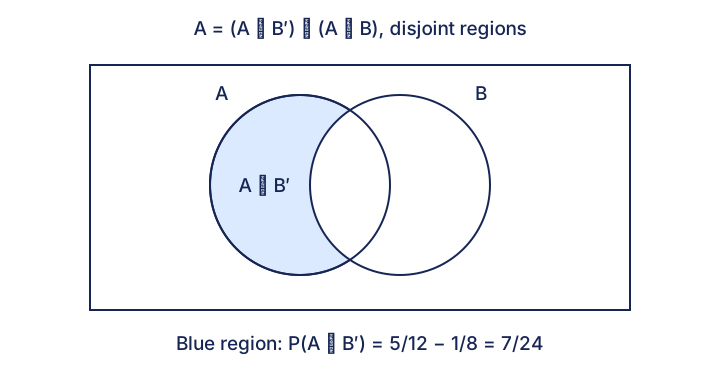
(i) Split A into two disjoint pieces
, so . By the given conditional probability, . Hence and .
(ii) Condition on B
.
(iii) Reverse the conditioning carefully
. The numerator is the same intersection, but the conditioning denominator changes.
(iv) Use inclusion–exclusion
.
Check independence and mutual exclusivity separately
, so A and B are not independent. Also , so they are not mutually exclusive.
Compare your sketch
Expand diagramFit diagram to page
Use the scrollbars or arrow keys to inspect details.
Common mistakes
A conditional probability is not generally the corresponding marginal; independence and mutual exclusivity are different conditions.
Solution notes
All printed asks, working, probability calculations and source annotations visually compared and retained. No marks are printed for this question.