Porisma

Worked solution

Recover a marginal probability from a conditional one

Events A and B satisfy P(A)=5/12P(A)=5/12, P(A∣B′)=7/12P(A\mid B')=7/12 and P(A∩B)=1/8P(A\cap B)=1/8. Find

(i) P(B)P(B),

(ii) P(A∣B)P(A\mid B),

(iii) P(B∣A)P(B\mid A),

(iv) P(A∪B)P(A\cup B).

State, with reasons, whether A and B are independent or mutually exclusive.

CJC · Discussion · Question 2

Answer

(i) 1/21/2; (ii) 1/41/4; (iii) 3/103/10; (iv) 19/2419/24. Neither independent nor mutually exclusive.

(i) Split A into two disjoint pieces

P(A)=P(A∩B′)+P(A∩B)P(A)=P(A\cap B')+P(A\cap B), so P(A∩B′)=5/12−1/8=7/24P(A\cap B')=5/12-1/8=7/24. By the given conditional probability, 7/12=P(A∩B′)/P(B′)=(7/24)/P(B′)7/12=P(A\cap B')/P(B')=(7/24)/P(B'). Hence P(B′)=1/2P(B')=1/2 and P(B)=1−P(B′)=1/2P(B)=1-P(B')=1/2.

How did this part go?

(ii) Condition on B

P(A∣B)=P(A∩B)/P(B)=(1/8)/(1/2)=1/4P(A\mid B)=P(A\cap B)/P(B)=(1/8)/(1/2)=1/4.

How did this part go?

(iii) Reverse the conditioning carefully

P(B∣A)=P(B∩A)/P(A)=(1/8)/(5/12)=3/10P(B\mid A)=P(B\cap A)/P(A)=(1/8)/(5/12)=3/10. The numerator is the same intersection, but the conditioning denominator changes.

How did this part go?

(iv) Use inclusion–exclusion

P(A∪B)=P(A)+P(B)−P(A∩B)=5/12+1/2−1/8=19/24P(A\cup B)=P(A)+P(B)-P(A\cap B)=5/12+1/2-1/8=19/24.

How did this part go?

Check independence and mutual exclusivity separately

P(A)P(B)=(5/12)(1/2)=5/24≠1/8=P(A∩B)P(A)P(B)=(5/12)(1/2)=5/24\ne1/8=P(A\cap B), so A and B are not independent. Also P(A∩B)=1/8≠0P(A\cap B)=1/8\ne0, so they are not mutually exclusive.

How did this part go?

Compare your sketch

Expand diagram

Use the scrollbars or arrow keys to inspect details.
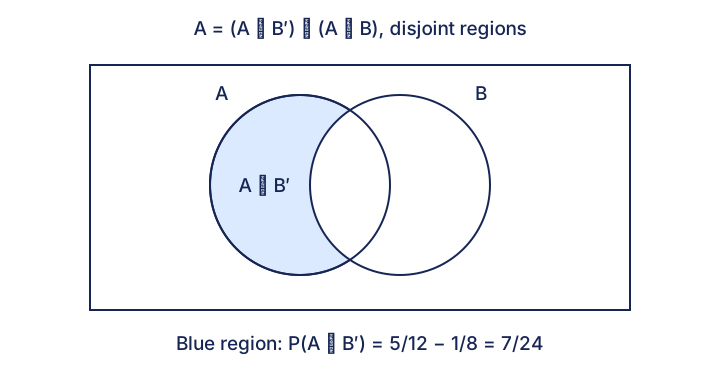
Two overlapping event circles A and B inside a sample-space rectangle. Only A outside B is blue, reconstructing the source shaded A intersection B-complement. That probability is 7/24; the diagram is not to scale.

Common mistakes

A conditional probability is not generally the corresponding marginal; independence and mutual exclusivity are different conditions.

Solution notes

All printed asks, working, probability calculations and source annotations visually compared and retained. No marks are printed for this question.

Read the hint