Worked solution
Use base rates before interpreting a positive result
A certain disease is present in 1 in 200 of the population. In a mass screening programme, a quick test is used but is not totally reliable. For someone with the disease, the probability of a positive result is 0.9; for someone without it, the probability of a positive result is 0.02.
(a) A person is chosen at random and tested.
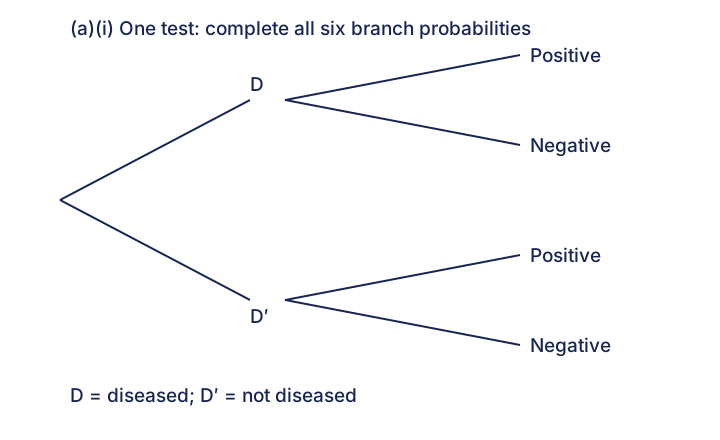
(i) Copy and complete the tree diagram illustrating one test.
(ii) Find the probability that the person has the disease and the test is positive.
(iii) Find the probability that the test is negative.
(iv) Given a positive result, find the probability that the person has the disease.
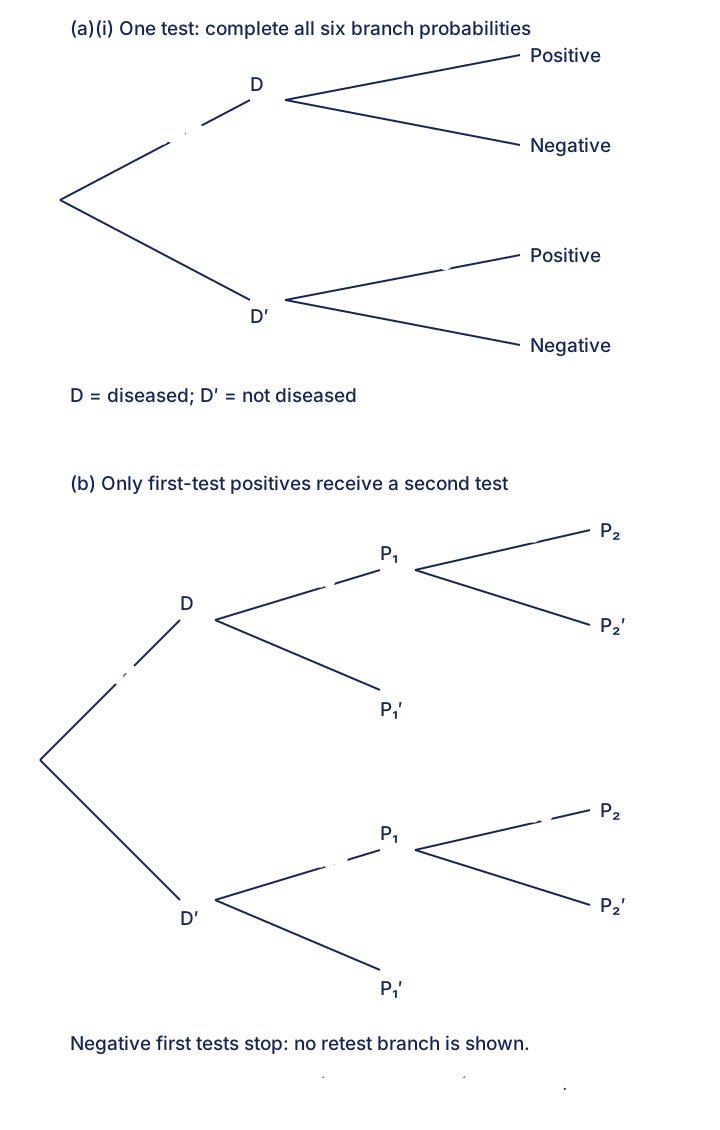
(b) People with a positive result are recalled and re-tested. Find the probability that a person has the disease if the second test also proves positive.
Expand diagramFit diagram to page
Use the scrollbars or arrow keys to inspect details.
[1997/II/3]
CJC · Discussion · Question 5
Answer
(a)(ii) ; (iii) ; (iv) . (b) under the source’s conditional-independence retest model.
(a)(i) Complete the source’s one-test tree
Let D denote disease and P a positive result. The initial branches are and . Given D, positive/negative probabilities are and . Given no disease, they are and . The two outgoing probabilities at each branching point add to 1. The source’s teaching note identifies tree diagrams and conditional probability, referring to Lecture Example 8.
(a)(ii) Multiply along the disease-positive path
.
(a)(iii) Add the two disjoint negative paths
.
(a)(iv) Condition on all positives
. The denominator includes positives from both disease-status groups; the test’s 0.9 rate is not this posterior probability.
(b) Interpret the source’s retest model explicitly
Let P₁ and P₂ mean positive results on the first and second tests. Only P₁-positive people are retested. The source reuses 0.9 and 0.02 on the second test, assuming the test results are independent conditional on disease status and that these status-specific rates stay the same. This is an extra modelling assumption; one-test accuracy alone does not establish it.
(b) Divide the two-positive disease path by all two-positive paths
Under that assumption,
The source writes in the recalled group; its numerator/denominator and tree show that both tests are positive. The full conditioning event is made explicit here.
Compare your sketch
Expand diagramFit diagram to page
Use the scrollbars or arrow keys to inspect details.
Common mistakes
Positive-given-disease differs from disease-given-positive. Repeated-test multiplication requires conditional independence; it is not implied by the first-test rates.
Solution notes
All five asks, blank/completed single-test trees, positive-only retest tree, exact values and source 3 s.f.answer retained. Source Lecture Example 8 teaching note integrated. The source’s implicit status-conditional independence and shorthandP₂ conditioning are explicitly qualified; original native text unchanged.