Probability and conditional information
Practice section 5 of 8
Questions 25–30 in this collection
Practice questions
Discussion practice · 1 of 6
Distinguish not-all-together from pairwise separation
A group of fifteen people consists of one pair of sisters, one set of three brothers and ten other people. They are arranged randomly in a line.
(i) Find the probability that the sisters are next to each other.
(ii) Find the probability that the brothers are not all next to one another.
(iii) Find the probability that the sisters are next to each other and the brothers are all next to one another.
(iv) Find the probability that either the sisters are next to each other or the brothers are all next to one another or both.
Instead the fifteen people are arranged in a circle.
(v) Find the probability that the sisters are next to each other.
[2012/II/7]
CJC · Discussion · Question 4
Solution
Discussion practice · 2 of 6
Use base rates before interpreting a positive result
A certain disease is present in 1 in 200 of the population. In a mass screening programme, a quick test is used but is not totally reliable. For someone with the disease, the probability of a positive result is 0.9; for someone without it, the probability of a positive result is 0.02.
(a) A person is chosen at random and tested.
(i) Copy and complete the tree diagram illustrating one test.
(ii) Find the probability that the person has the disease and the test is positive.
(iii) Find the probability that the test is negative.
(iv) Given a positive result, find the probability that the person has the disease.
(b) People with a positive result are recalled and re-tested. Find the probability that a person has the disease if the second test also proves positive.
Expand diagramFit diagram to page
Use the scrollbars or arrow keys to inspect details.
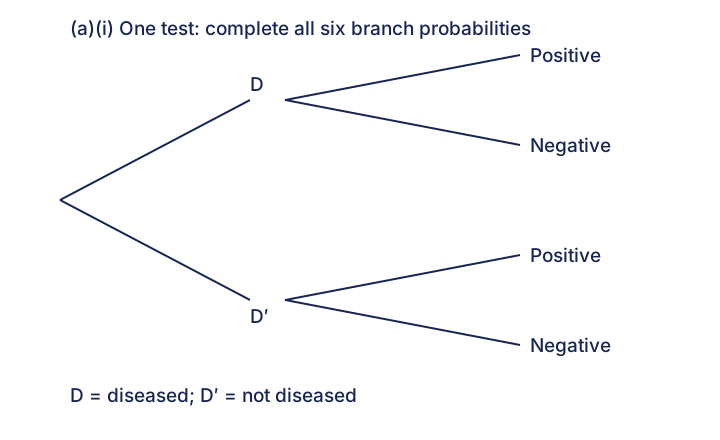
[1997/II/3]
CJC · Discussion · Question 5
Solution
Discussion practice · 3 of 6
Use overlap bounds before adding the conditional information
For events A and B, and .
(i) Find the greatest and least possible values of .
It is given in addition that .
(ii) Find .
(iii) Find .
(iv) Determine if A and B are independent.
(v) Another event C satisfies , and . Find .
[2016/RI/P2/10]
CJC · Discussion · Question 6
Solution
Discussion practice · 4 of 6
Sum mutually exclusive winning rounds as a geometric series
Two players A and B each have three cards showing elephant, cat and mouse. They flash their cards simultaneously. Elephant defeats cat, cat defeats mouse, and mouse defeats elephant. Matching animals draw. In each round, A chooses elephant, cat and mouse with probabilities 0.3,0.3,0.4; B’s corresponding probabilities are 0.2,0.5,0.3. Play continues until there is a winner.
Find the probability that
(i) a round ends in a draw;
(ii) A wins the first round;
(iii) B wins the first round given that it is not a draw;
(iv) B wins the contest.
[2008/JJC/II/7]
CJC · Discussion · Question 7
Solution
Discussion practice · 5 of 6
Differentiate the posterior probability over its percentage domain
In another National Eye Centre survey, p% are boys and the rest are girls. The probability a randomly chosen boy wears spectacles is 0.3, and for a randomly chosen girl it is 0.24.
(i) Find p if a randomly chosen child wears spectacles with probability 0.267.
(ii) For general p, let f(p) be the probability that a randomly chosen child who wears spectacles is a girl. Show that . Prove by differentiation that f is decreasing for , and explain the statement in context.
[2017/MI/II/6]
CJC · Discussion · Question 8
Solution
Review practice · 6 of 6
Solve for a parameter and enforce probability bounds
Events A and B are such that , and .
Given A and B are independent, find the value of k. [3]
[2014/PJC/II/6]
CJC · Review problems · Question 1