A hint to get started
Use base rates before interpreting a positive result
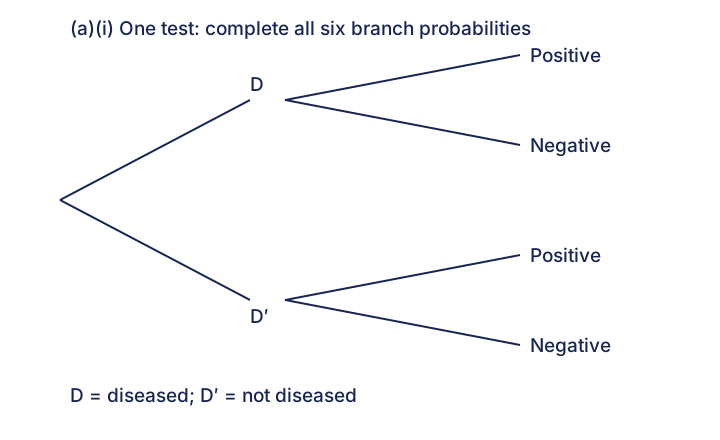
A certain disease is present in 1 in 200 of the population. In a mass screening programme, a quick test is used but is not totally reliable. For someone with the disease, the probability of a positive result is 0.9; for someone without it, the probability of a positive result is 0.02.
(a) A person is chosen at random and tested.
(i) Copy and complete the tree diagram illustrating one test.
(ii) Find the probability that the person has the disease and the test is positive.
(iii) Find the probability that the test is negative.
(iv) Given a positive result, find the probability that the person has the disease.
(b) People with a positive result are recalled and re-tested. Find the probability that a person has the disease if the second test also proves positive.
Expand diagramFit diagram to page
Use the scrollbars or arrow keys to inspect details.
[1997/II/3]
CJC · Discussion · Question 5
Multiply along a tree path; add disjoint paths before conditioning.