Porisma

Worked solution

Use overlap bounds before adding the conditional information

For events A and B, P(A)=5/8P(A)=5/8 and P(B)=2/3P(B)=2/3.

(i) Find the greatest and least possible values of P(A∩B)P(A\cap B).

It is given in addition that P(A′∣B′)=3/8P(A'\mid B')=3/8.

(ii) Find P(A′∩B′)P(A'\cap B').

(iii) Find P(A∪B)P(A\cup B).

(iv) Determine if A and B are independent.

(v) Another event C satisfies P(C)=3/8P(C)=3/8, P(A∩C)=P(B∩C)=1/4P(A\cap C)=P(B\cap C)=1/4 and P(A∪B∪C)=11/12P(A\cup B\cup C)=11/12. Find P(A∩B∩C)P(A\cap B\cap C).

[2016/RI/P2/10]

CJC · Discussion · Question 6

Answer

(i) greatest 5/85/8, least 7/247/24; (ii) 1/81/8; (iii) 7/87/8; (iv) independent; (v) 1/61/6.

(i) Greatest possible overlap

The overlap cannot exceed the smaller marginal. Since 5/8<2/35/8<2/3, the maximum is 5/85/8, attained when A is contained in B, as in the source’s nested-circle construction.

How did this part go?

(i) Least possible overlap

Inclusion–exclusion gives P(A∩B)=P(A)+P(B)−P(A∪B)≥5/8+2/3−1=7/24P(A\cap B)=P(A)+P(B)-P(A\cup B)\ge5/8+2/3-1=7/24. Equality is attained when A∪BA\cup B fills the sample space. The source’s overlap-strip construction and highlighted explanation illustrate this equality case. These extremes use only the two initial marginals, before the later conditional datum.

How did this part go?

(ii) Apply the given conditional probability

P(B′)=1−2/3=1/3P(B')=1-2/3=1/3. Thus 3/8=P(A′∩B′)/P(B′)3/8=P(A'\cap B')/P(B') gives P(A′∩B′)=(3/8)(1/3)=1/8P(A'\cap B')=(3/8)(1/3)=1/8.

How did this part go?

(iii) Complement the outside-both region

By De Morgan’s law, P(A∪B)=1−P(A′∩B′)=1−1/8=7/8P(A\cup B)=1-P(A'\cap B')=1-1/8=7/8.

How did this part go?

(iv) Method 1: compare the intersection with the product

From 7/8=5/8+2/3−P(A∩B)7/8=5/8+2/3-P(A\cap B), the intersection is 5/125/12. Also P(A)P(B)=(5/8)(2/3)=5/12P(A)P(B)=(5/8)(2/3)=5/12. Equality proves independence.

How did this part go?

(iv) Method 2: the source’s complement criterion

P(A′)=1−5/8=3/8=P(A′∣B′)P(A')=1-5/8=3/8=P(A'\mid B'). Since P(B′)>0P(B')>0, the complement events A′ and B′ are independent. Independence is preserved by taking complements, so A and B are independent too.

How did this part go?

(v) Use three-event inclusion–exclusion

P(A∪B∪C)=P(A)+P(B)+P(C)−P(A∩B)−P(A∩C)−P(B∩C)+P(A∩B∩C).\begin{aligned}&P(A\cup B\cup C)\\ & =P(A)+P(B)+P(C)\\ &{}-P(A\cap B)-P(A\cap C)-P(B\cap C)\\ &{}+P(A\cap B\cap C).\end{aligned}

Substitute the source values:

1112=58+23+38−512−14−14+P(A∩B∩C).\begin{aligned}&\frac{11}{12}\\ & =\frac58+\frac23+\frac38-\frac5{12}-\frac14-\frac14\\ &{}+P(A\cap B\cap C).\end{aligned}

Hence P(A∩B∩C)=1/6P(A\cap B\cap C)=1/6. The retained three-circle region diagram shows why the triple overlap is restored once after subtracting all pairwise overlaps.

How did this part go?

Compare your sketch

Expand diagram

Use the scrollbars or arrow keys to inspect details.
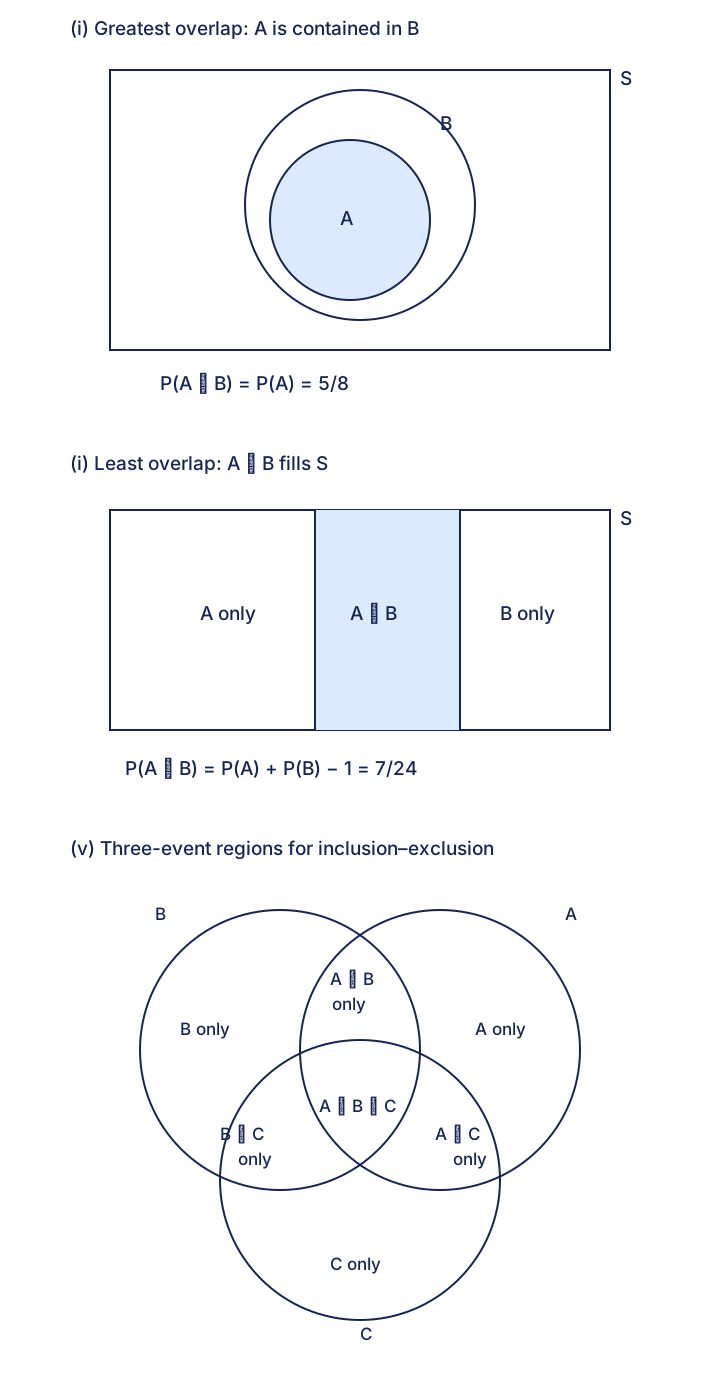
Three source panels. Greatest overlap: A inside B, intersection 5/8. Least: A union B fills the sample rectangle, intersection 7/24. Last: B left,A right,C below; all seven Venn regions labelled, including the central triple intersection. Schematics are not area-proportional.

Common mistakes

The bounds in(i) precede the extra conditional information. Independence must be established from the later data, not assumed to obtain the bounds.

Solution notes

All five asks, both independence methods, all three source diagram panels and highlighted minimum-overlap reasoning retained. Shapes are schematic, not probability-area diagrams. All native text retained; no marks printed.

Read the hint