Worked solution
Differentiate the posterior probability over its percentage domain
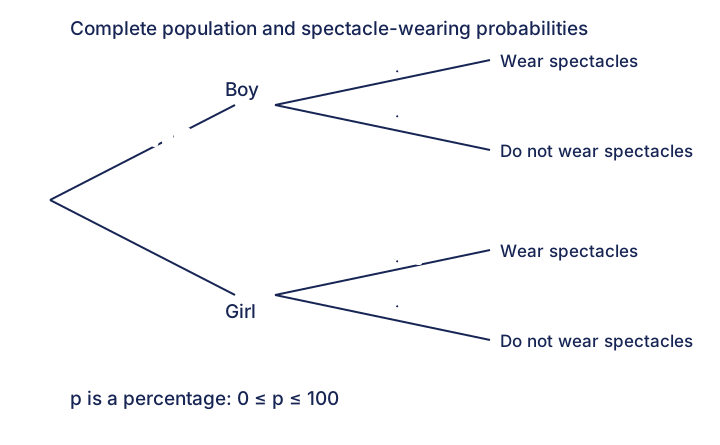
In another National Eye Centre survey, p% are boys and the rest are girls. The probability a randomly chosen boy wears spectacles is 0.3, and for a randomly chosen girl it is 0.24.
(i) Find p if a randomly chosen child wears spectacles with probability 0.267.
(ii) For general p, let f(p) be the probability that a randomly chosen child who wears spectacles is a girl. Show that . Prove by differentiation that f is decreasing for , and explain the statement in context.
[2017/MI/II/6]
CJC · Discussion · Question 8
Answer
(i) . (ii) and for , with the stated population-composition interpretation.
(i) Use total probability from the source tree
The boy/girl probabilities are and ; their spectacle/no-spectacle branches are 0.3/0.7 and 0.24/0.76. Thus . Simplifying gives , so .
(ii) Condition on wearing spectacles
Preserve the source simplification stages:
(ii) Differentiate and establish the correct interval
By the quotient rule,
On , the denominator is positive, so and f is decreasing. The source’s last line prints “for all real p”; the rational expression is undefined at p=−400. The requested probability domain is the percentage interval[0,100], and the proof here is confined to that interval.
(ii) Interpret the change in context
As the percentage of boys in the surveyed population increases, the probability that a randomly chosen spectacle-wearing child is a girl decreases. This changes the composition of spectacle wearers; it does not change either within-group wearing probability 0.3 or 0.24.
Compare your sketch
Expand diagramFit diagram to page
Use the scrollbars or arrow keys to inspect details.
Common mistakes
p is a percentage, not a fraction. Do not extend the source’s monotonicity statement to all real numbers across a pole.
Solution notes
Both source asks, all six tree branches, every fraction simplification stage, quotient-rule calculation and contextual conclusion retained. The source’s all-real derivative-domain claim is explicitly restricted to the requested[0,100]; native original preserved. No printed marks.