Worked solution
Use a logarithmic fixed-point graph to compare terms
The diagram shows . Its positive root is . Find . Positive terms satisfy .
(i) Prove algebraically that convergence implies limit .
(ii) Use a calculator to describe the behaviour for and .
(iii) By considering , prove increase when and decrease when .
Expand diagramFit diagram to page
Use the scrollbars or arrow keys to inspect details.
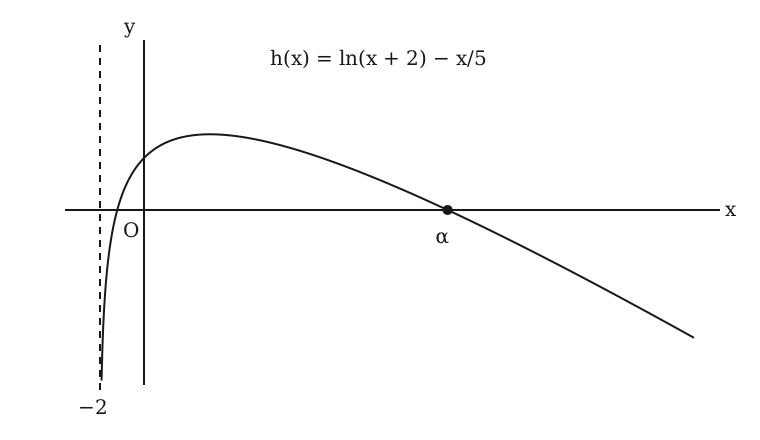
[2008/IJC/MYE/12(modified)]
CJC · Discussion · Question 15
Answer
(3 s.f.); increasing from , decreasing from , both towards .
Locate the positive root
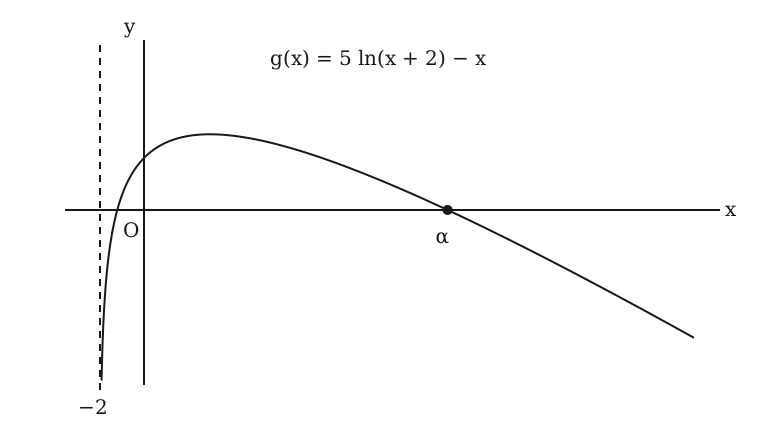
Solving numerically gives , or to 3 significant figures. With , , changes sign at , and . Thus there is exactly one positive root.
(i) Pass to the limit algebraically
If the positive sequence converges to , then , so . Since and the positive root is unique, .
(ii) Retain the calculator observations
For , the printed selected terms are:
| n | xₙ |
|---|---|
| 1 | 1 |
| 2 | 5.49 |
| 3 | 10.07 |
| 6 | 13.7 |
| 7 | 13.8 |
| 8 | 13.8 |
The terms increase towards . For :
| n | xₙ |
|---|---|
| 1 | 20 |
| 2 | 15.5 |
| 3 | 14.3 |
| 4 | 14.0 |
| 5 | 13.8 |
| 6 | 13.8 |
The terms decrease towards . Rounded repetitions of 13.8 are not exact equality.
The calculator screenshots also show all eleven rows at their displayed precision. Enter the same recurrence in sequence mode and change only the initial value between the two runs:
| n | xₙ from x₁=1 | xₙ from x₁=20 |
|---|---|---|
| 1 | 1 | 20 |
| 2 | 5.4931 | 15.455 |
| 3 | 10.07 | 14.298 |
| 4 | 12.454 | 13.955 |
| 5 | 13.355 | 13.849 |
| 6 | 13.657 | 13.816 |
| 7 | 13.755 | 13.805 |
| 8 | 13.786 | 13.802 |
| 9 | 13.796 | 13.801 |
| 10 | 13.799 | 13.8 |
| 11 | 13.8 | 13.8 |
The shorter printed tables above use different rounding from the calculator screenshots. Both display versions are retained; these rounded repetitions do not mean the recurrence has reached its exact fixed point.
(iii) Use the sign of the increment
. For , , giving ; for , , giving . Since is increasing and fixes , a term below stays below it, and a term above stays above. The two observed sequences are therefore monotone and bounded and converge to .
Compare your sketch
Expand diagramFit diagram to page
Use the scrollbars or arrow keys to inspect details.
Common mistakes
Rounded calculator terms can repeat before the sequence actually reaches its limit.