Porisma

Worked solution

Prove a projection formula in two ways

The angle between two unit vectors a\mathbf a and b\mathbf b is θ\theta.

By expanding the scalar product, show that (3a−b)⋅(a+3b)=8cos⁡θ(3\mathbf a-\mathbf b)\cdot(\mathbf a+3\mathbf b)=8\cos\theta.

Given that θ=60∘\theta=60^\circ, show that the length of projection of (3a−b)(3\mathbf a-\mathbf b) onto (a+3b)(\mathbf a+3\mathbf b) is 413\dfrac4{\sqrt{13}}.

CJC · Discussion · Question 6

Answer

Expanded product 8cos⁡θ8\cos\theta; at 60°, ∣a+3b∣=13|\mathbf a+3\mathbf b|=\sqrt{13} and projection length 4/134/\sqrt{13}.

Expand and use both unit magnitudes

(3a−b)⋅(a+3b)=3a⋅a−b⋅a+9a⋅b−3b⋅b=3∣a∣2+8a⋅b−3∣b∣2=8cos⁡θ.\begin{aligned}(3\mathbf a-\mathbf b)\cdot(\mathbf a+3\mathbf b)&=3\mathbf a\cdot\mathbf a-\mathbf b\cdot\mathbf a+9\mathbf a\cdot\mathbf b-3\mathbf b\cdot\mathbf b\\&=3|\mathbf a|^2+8\mathbf a\cdot\mathbf b-3|\mathbf b|^2\\&=8\cos\theta.\end{aligned}

The terms 3 and −3 cancel because both vectors are unit vectors.

How did this part go?

Denominator, method 1: cosine rule

At θ=60∘\theta=60^\circ, the head-to-tail triangle for a+3b\mathbf a+3\mathbf b has internal angle 120∘120^\circ. Thus

∣a+3b∣2=12+32−2(1)(3)cos⁡120∘=13.\begin{aligned}&|\mathbf a+3\mathbf b|^2\\ & =1^2+3^2-2(1)(3)\cos 120^\circ\\ & =13.\end{aligned}

Hence ∣a+3b∣=13|\mathbf a+3\mathbf b|=\sqrt{13}. The reconstructed figure preserves the source’s 60°/120° relation.

How did this part go?

Denominator, method 2: scalar product

∣a+3b∣2=(a+3b)⋅(a+3b)=∣a∣2+6a⋅b+9∣b∣2=1+6cos⁡60∘+9=13.\begin{aligned}|\mathbf a+3\mathbf b|^2&=(\mathbf a+3\mathbf b)\cdot(\mathbf a+3\mathbf b)\\&=|\mathbf a|^2+6\mathbf a\cdot\mathbf b+9|\mathbf b|^2\\&=1+6\cos 60^\circ+9=13.\end{aligned}

How did this part go?

Apply the projection-length formula

The nonnegative projection length is

∣(3a−b)⋅(a+3b)∣∣a+3b∣=∣8cos⁡60∘∣13=413.\begin{aligned}&\frac{|(3\mathbf a-\mathbf b)\cdot(\mathbf a+3\mathbf b)|}{|\mathbf a+3\mathbf b|}\\ & =\frac{|8\cos 60^\circ|}{\sqrt{13}}\\ & =\frac 4{\sqrt{13}}.\end{aligned}

Absolute-value bars are retained even though the numerator is positive in this case.

How did this part go?

Compare your sketch

Expand diagram

Use the scrollbars or arrow keys to inspect details.
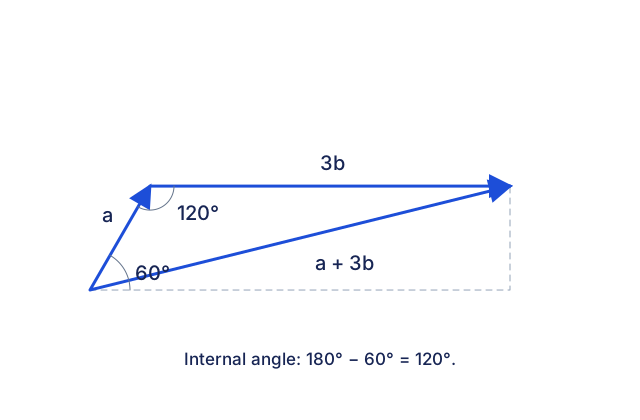
Vector a has unit length and makes 60 degrees with vector b. A head-to-tail arrow 3b of length 3 units follows a; their resultant is a+3b. The internal triangle angle is 120 degrees, supplementary to 60 degrees. Dashed horizontal guides are parallel to b.

Common mistakes

Divide by the magnitude of the vector being projected onto; retain an absolute value when asking for length.

Solution notes

Both printed denominator methods and the source angle diagram retained through an independent reconstruction. Missing extraction radicals and magnitude bars are restored from the rendered page.

Read the hint