Porisma

Worked solution

Check membership and a point-to-line distance

Given a line with vector equation r=(i+2j+3k)+λ(i+2j+5k)\mathbf r=(\mathbf i+2\mathbf j+3\mathbf k)+\lambda(\mathbf i+2\mathbf j+5\mathbf k), λ∈R\lambda\in\mathbb R,

(i) show that point A(3,6,13)A(3,6,13) lies on the line,

(ii) find the perpendicular distance from point B(1,7,4)B(1,7,4) to the line.

CJC · Discussion · Question 3

Answer

(i) λ=2\lambda=2 in all components. (ii) Distance 37/2\sqrt{37/2} units.

(i) Check every component

3=1+λ3=1+\lambda, 6=2+2λ6=2+2\lambda and 13=3+5λ13=3+5\lambda each give λ=2\lambda=2. Thus A lies on the line.

How did this part go?

(ii) Select a point and unit direction

Let C=(1,2,3)C=(1,2,3) and m=(1,2,5)\mathbf m=(1,2,5). Then CB→=(0,5,1)\overrightarrow{CB}=(0,5,1), ∣m∣=30|\mathbf m|=\sqrt{30} and m^=m/30\widehat{\mathbf m}=\mathbf m/\sqrt{30}.

How did this part go?

(ii) Cross-product height

h=∣CB×m^∣=∣(0,5,1)×(1,2,5)∣30.\begin{aligned}&h\\ & =|CB\times\widehat{\mathbf m}|\\ & =\frac{|(0,5,1)\times(1,2,5)|}{\sqrt{30}}.\end{aligned}

The cross product is (23,1,−5)(23,1,-5) with squared norm 555. Thus

h=55530=372 units.h=\frac{\sqrt{555}}{\sqrt{30}}=\sqrt{\frac{37}{2}}\text{ units}.

How did this part go?

Compare your sketch

Expand diagram

Use the scrollbars or arrow keys to inspect details.
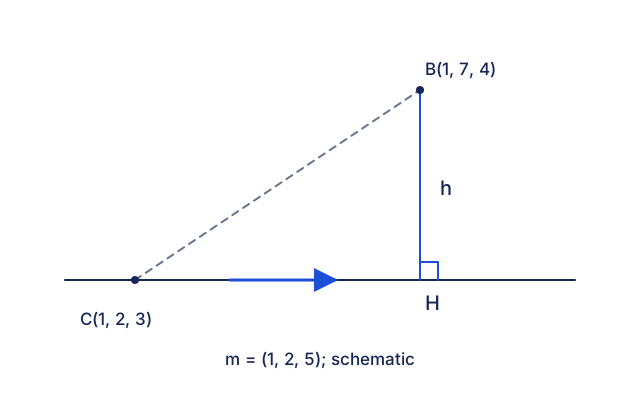
Planar schematic: C(1,2,3) is on a line with direction m=(1,2,5). B(1,7,4) lies above the perpendicular foot H. Dashed CB is the hypotenuse and BH is height h. H is an added explanatory foot label, not a spatial coordinate plot.

Common mistakes

Divide by the direction magnitude if it is not already a unit vector. One matching coordinate does not establish membership.

Solution notes

Every source step and the C/B/m/h diagram retained in a qualified reconstruction; magnitude bars and radicals restored visually.

Read the hint