Porisma

Worked solution

Find the separation of two parallel lines

Given the two lines l1:4(1−x)=y=2z+4l_1:4(1-x)=y=2z+4 and l2:8−4x=y+3=2zl_2:8-4x=y+3=2z, explain why they are parallel. Find the distance between the two lines.

CJC · Discussion · Question 6

Answer

The lines have common direction (−1,4,2)(-1,4,2) and distance 71/7\sqrt{71/7} units.

Compare directions

Setting each common expression equal to a real parameter gives

l1:r=(1,0,−2)+t(−1/4,1,1/2),l2:r=(2,−3,0)+s(−1/4,1,1/2).l_1:\mathbf r=(1,0,-2)+t(-1/4,1,1/2),\qquad l_2:\mathbf r=(2,-3,0)+s(-1/4,1,1/2).

Both have direction m=(−1,4,2)\mathbf m=(-1,4,2). Their reference-point displacement (1,−3,2)(1,-3,2) is not a multiple of m, so they are distinct parallel lines.

How did this part go?

Method 1: projection and Pythagoras

Choose A=(1,0,−2)A=(1,0,-2) and B=(2,−3,0)B=(2,-3,0). Then AB=(1,−3,2)AB=(1,-3,2), ∣AB∣2=14|AB|^2=14, ∣m∣2=21|\mathbf m|^2=21 and AB⋅m=−9AB\cdot\mathbf m=-9. The projection length is

d′=∣AB⋅m∣∣m∣=921.d^{\prime}=\frac{|AB\cdot\mathbf m|}{|\mathbf m|}=\frac 9{\sqrt{21}}.

The signed component is negative, but its length is positive. Hence

d=∣AB∣2−(d′)2=14−8121=717.\begin{aligned}&d\\ & =\sqrt{|AB|^2-(d^{\prime})^2}\\ & =\sqrt{14-\frac{81}{21}}\\ & =\sqrt{\frac{71}{7}}.\end{aligned}

How did this part go?

Method 2: cross-product height

AB×m=(1,−3,2)×(−1,4,2)=(−14,−4,1).\begin{aligned}&AB\times\mathbf m\\ & =(1,-3,2)\times(-1,4,2)\\ & =(-14,-4,1).\end{aligned}

Thus

d=∣AB×m∣∣m∣=21321=717 units.\begin{aligned}&d\\ & =\frac{|AB\times\mathbf m|}{|\mathbf m|}\\ & =\frac{\sqrt{213}}{\sqrt{21}}\\ & =\sqrt{\frac{71}{7}}\text{ units}.\end{aligned}

How did this part go?

Compare your sketch

Expand diagram

Use the scrollbars or arrow keys to inspect details.
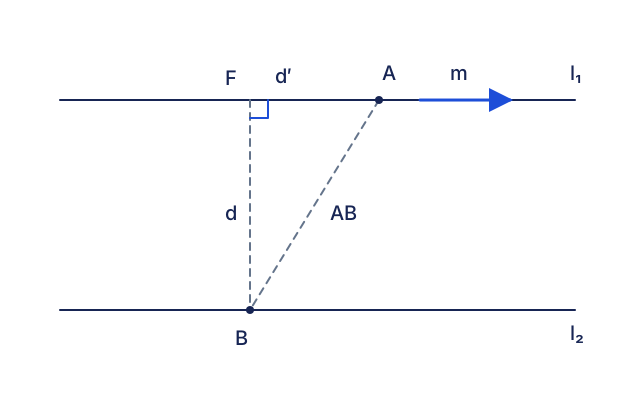
Parallel lines l1 and l2 have common direction m=(-1,4,2). A=(1,0,-2) is on l1, B=(2,-3,0) on l2. The foot F of B on l1 lies opposite the positive m direction from A: the signed projection of AB is negative. The nonnegative component length d-prime and perpendicular distance d form a right triangle. Planar schematic, not a coordinate plot.

Common mistakes

A projection length uses an absolute value; the signed component here is negative.

Solution notes

Both printed methods and their exact radical results retained. The reconstructed right-triangle figure retains A,B,m,d,d′ and places the foot consistently with the negative signed projection; it is a planar schematic.

Read the hint