Porisma

Worked solution

Use two line parameters, a division ratio and a cross-product area

With reference to an origin OO, the points AA, BB, CC and DD are such that OA→=a\overrightarrow{OA}=\mathbf a, OB→=b\overrightarrow{OB}=\mathbf b, OC→=3a−b\overrightarrow{OC}=3\mathbf a-\mathbf b and OD→=2a+3b\overrightarrow{OD}=2\mathbf a+3\mathbf b. The lines BCBC and ADAD intersect at point XX (see diagram).

(i) Express OX→\overrightarrow{OX} in terms of a\mathbf a and b\mathbf b.

(ii) The point YY on BCBC is such that BY:YC=2:11BY:YC=2:11. Show that the points OO, YY and DD are collinear.

(iii) Find the ratio of the area of triangle OABOAB to the area of triangle BCDBCD.

Expand diagram

Use the scrollbars or arrow keys to inspect details.
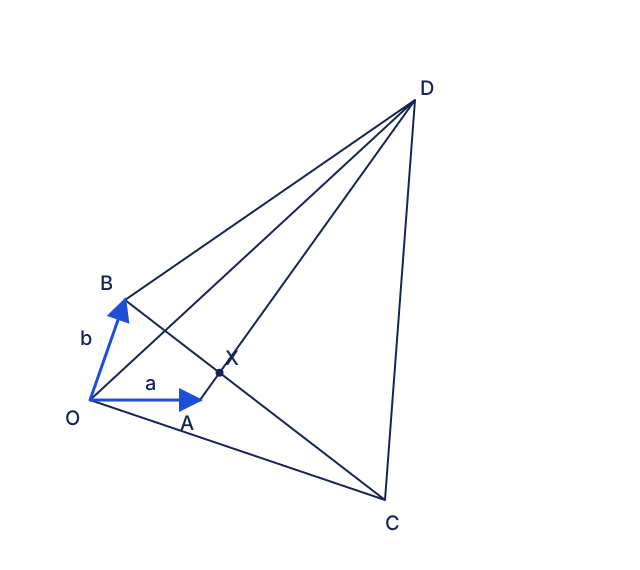
O is the origin; OA=a and OB=b are nonparallel. C has position 3a-b and D has position 2a+3b. Segments BC and AD meet at X. Coordinates in this independent planar embedding illustrate the vector relations only; they are not additional numerical data.

[2022/RVHS/J2MYE/I/3]

CJC · Discussion · Question 9

Answer

OX=1211a+311bOX=\frac{12}{11}\mathbf a+\frac 3{11}\mathbf b; OY=313ODOY=\frac 3{13}OD; area ratio 1:101:10.

(i) Method 1: simultaneous line parameters

On BC,

r=b+λ(3a−2b)=3λa+(1−2λ)b.\begin{aligned}&\mathbf r\\ & =\mathbf b+\lambda(3\mathbf a-2\mathbf b)\\ & =3\lambda\mathbf a+(1-2\lambda)\mathbf b.\end{aligned}

On AD,

r=a+μ(a+3b)=(1+μ)a+3μb.\begin{aligned}&\mathbf r\\ & =\mathbf a+\mu(\mathbf a+3\mathbf b)\\ & =(1+\mu)\mathbf a+3\mu\mathbf b.\end{aligned}

Since a,b are nonparallel in the diagram, compare coefficients: 3λ−μ=13\lambda-\mu=1, 2λ+3μ=12\lambda+3\mu=1. Thus λ=4/11\lambda=4/11, μ=1/11\mu=1/11 and

OX=1211a+311b.OX=\frac{12}{11}\mathbf a+\frac 3{11}\mathbf b.

How did this part go?

(i) Method 2: internal division

Use the source alternative parameters AX:XD=λ:(1−λ)AX:XD=\lambda:(1-\lambda) and BX:XC=μ:(1−μ)BX:XC=\mu:(1-\mu). The section formula gives

OX=(1+λ)a+3λb=3μa+(1−2μ)b.\begin{aligned}&OX\\ & =(1+\lambda)\mathbf a+3\lambda\mathbf b\\ & =3\mu\mathbf a+(1-2\mu)\mathbf b.\end{aligned}

Thus 1+λ=3μ1+\lambda=3\mu and 3λ=1−2μ3\lambda=1-2\mu, giving λ=1/11\lambda=1/11, μ=4/11\mu=4/11 and the same OX. These parameters refer to the opposite lines from Method 1.

How did this part go?

(ii) Locate Y and compare OD

OY=2(3a−b)+11b13=313(2a+3b)=313OD.\begin{aligned}&OY\\ & =\frac{2(3\mathbf a-\mathbf b)+11\mathbf b}{13}\\ & =\frac 3{13}(2\mathbf a+3\mathbf b)\\ & =\frac 3{13}OD.\end{aligned}

Both vectors start at O and are parallel, so O,Y,D are collinear.

How did this part go?

(iii) Compare cross-product areas

BD=2a+2bBD=2\mathbf a+2\mathbf b and BC=3a−2bBC=3\mathbf a-2\mathbf b. Correctly expanding,

BD×BC=6a×a−4a×b+6b×a−4b×b=−10a×b.\begin{aligned}BD\times BC&=6\mathbf a\times\mathbf a-4\mathbf a\times\mathbf b+6\mathbf b\times\mathbf a-4\mathbf b\times\mathbf b\\&=-10\mathbf a\times\mathbf b.\end{aligned}

Hence area⁡(BCD)=10⋅12∣a×b∣\operatorname{area}(BCD)=10\cdot\frac 12|\mathbf a\times\mathbf b|, while area⁡(OAB)=12∣a×b∣\operatorname{area}(OAB)=\frac 12|\mathbf a\times\mathbf b|. The ratio is 1:101:10.

How did this part go?

Common mistakes

The two printed methods interchange the line associated with each parameter. Keep each method’s definitions together.

Solution notes

The PDF 14 cross-product expansion prints 6 a×b as its first term; it should be 6 a×a. The retained original records the slip; the corrected expansion above agrees with the source subsequent −10 a×b and final 1:10. Both printed intersection methods retained. The source figure is reconstructed before the answer, preserving O,A,B,C,D,X and a,b.

Read the hint