Discussion questions · Section 2 of 2
Questions 7–10 in this collection
Locate a perpendicular foot and reflect a whole line · Interpret parametric lines and zero cross products · +2 more
- 7
(i) Find a vector equation of the line through the points and with position vectors and respectively.
(ii) The perpendicular to this line from the point with position vector meets the line at the point . Find the position vector and the ratio of .
(iii) Find a Cartesian equation of the line which is a reflection of the line in the line .
[2012/I/9]
CJC · Discussion · Question 7
- 8
(a) Interpret geometrically the vector equation , where and are constant vectors and is a parameter.
(b) The points , and have position vectors , and respectively. The points and are fixed and varies. Given that is non-zero and , describe geometrically the set of all possible positions of the point .
CJC · Discussion · Question 8
- 9
With reference to an origin , the points , , and are such that , , and . The lines and intersect at point (see diagram).
(i) Express in terms of and .
(ii) The point on is such that . Show that the points , and are collinear.
(iii) Find the ratio of the area of triangle to the area of triangle .
Expand diagramFit diagram to page
Use the scrollbars or arrow keys to inspect details.
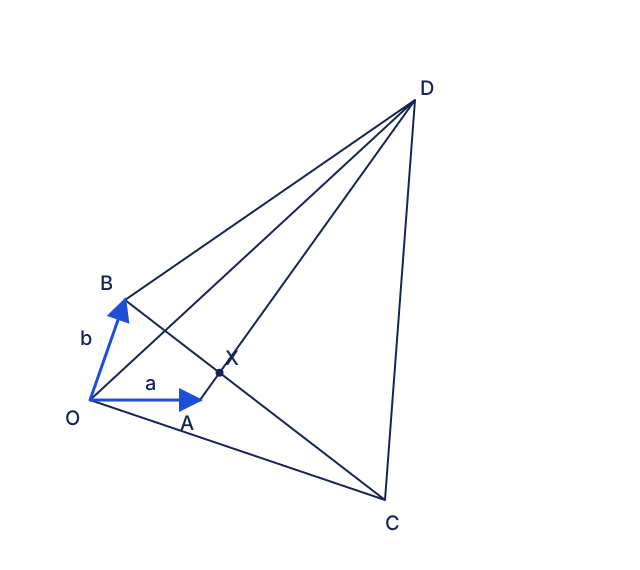
O is the origin; OA=a and OB=b are nonparallel. C has position 3a-b and D has position 2a +3b. Segments BC and AD meet at X. Coordinates in this independent planar embedding illustrate the vector relations only; they are not additional numerical data. [2022/RVHS/J2MYE/I/3]
CJC · Discussion · Question 9
- 10
Electrical engineers are installing electricity cables on a building site. Points are defined relative to a main switching site at , where units are metres. Cables are laid in straight lines and the widths of cables can be neglected.
An existing cable starts at the main switching site and goes in the direction .
A new cable is installed which passes through points and .
(i) Find the value of for which and the new cable will meet.
To ensure that the cables do not meet, the engineers use . The engineers wish to connect each of the points and to a point on .
(ii) The engineers wish to reduce the length of cable required and believe in order to do this that angle should be . Show that this is not possible.
(iii) The engineers discover that the ground between and is difficult to drill through and now decide to make the length of as small as possible. Find the coordinates of in this case and the exact minimum length.
[2017/I/10]
CJC · Discussion · Question 10