Porisma

A hint to get started

Use two line parameters, a division ratio and a cross-product area

With reference to an origin OO, the points AA, BB, CC and DD are such that OA→=a\overrightarrow{OA}=\mathbf a, OB→=b\overrightarrow{OB}=\mathbf b, OC→=3a−b\overrightarrow{OC}=3\mathbf a-\mathbf b and OD→=2a+3b\overrightarrow{OD}=2\mathbf a+3\mathbf b. The lines BCBC and ADAD intersect at point XX (see diagram).

(i) Express OX→\overrightarrow{OX} in terms of a\mathbf a and b\mathbf b.

(ii) The point YY on BCBC is such that BY:YC=2:11BY:YC=2:11. Show that the points OO, YY and DD are collinear.

(iii) Find the ratio of the area of triangle OABOAB to the area of triangle BCDBCD.

Expand diagram

Use the scrollbars or arrow keys to inspect details.
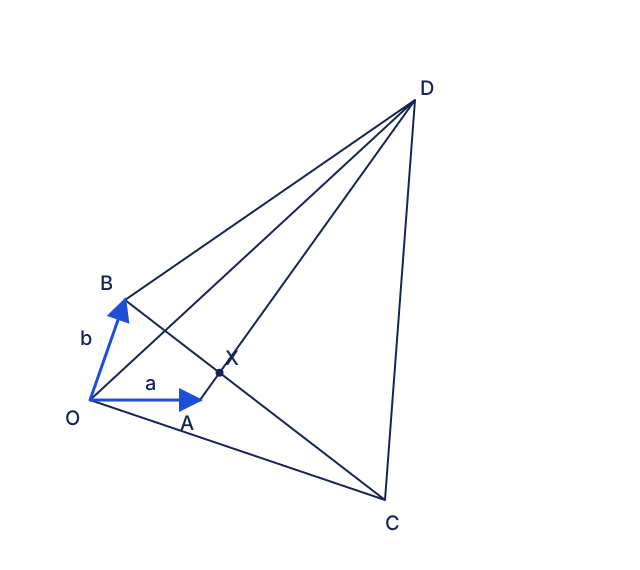
O is the origin; OA=a and OB=b are nonparallel. C has position 3a-b and D has position 2a+3b. Segments BC and AD meet at X. Coordinates in this independent planar embedding illustrate the vector relations only; they are not additional numerical data.

[2022/RVHS/J2MYE/I/3]

CJC · Discussion · Question 9

Compare a and b coefficients only because their directions are independent in the source diagram.

Read the worked solution