Worked solution
Model cable intersections and minimise drilling distance
Electrical engineers are installing electricity cables on a building site. Points are defined relative to a main switching site at , where units are metres. Cables are laid in straight lines and the widths of cables can be neglected.
An existing cable starts at the main switching site and goes in the direction .
A new cable is installed which passes through points and .
(i) Find the value of for which and the new cable will meet.
To ensure that the cables do not meet, the engineers use . The engineers wish to connect each of the points and to a point on .
(ii) The engineers wish to reduce the length of cable required and believe in order to do this that angle should be . Show that this is not possible.
(iii) The engineers discover that the ground between and is difficult to drill through and now decide to make the length of as small as possible. Find the coordinates of in this case and the exact minimum length.
[2017/I/10]
CJC · Discussion · Question 10
Answer
(i) for the full supporting lines (the source convention); no intersection on the forward ray. (ii) for every real . (iii) and minimum m.
(i) Intersect the supporting lines
Following the printed solution, write and the new cable , with real parameters. The equations
give , and . This is the source answer for full lines. If “starts at O and runs in the direction” means only the forward ray , there is no intersection for any a: the first two coordinates already force negative . Likewise the computed point is outside the finite segment PQ.
(ii) Test the right angle
Now and . Thus and . Their dot product is
It cannot be zero, so the angle cannot be . Alternatively its discriminant is , and its leading coefficient is positive. Its vertex is ; the source blue note incorrectly prints height .
(iii) Form the squared distance
Minimising this nonnegative quantity is equivalent to minimising PR.
(iii) Method 1: complete the square
The minimum occurs at .
(iii) Method 2 A: differentiate PR
The denominator is positive, and the source sign chart is:
| decreasing | minimum | increasing |
Thus PR is minimised at without needing the lengthy second derivative.
(iii) Method 2 B: differentiate the square
| decreasing | minimum | increasing |
Both the first-derivative sign change and the positive second derivative identify the same minimum.
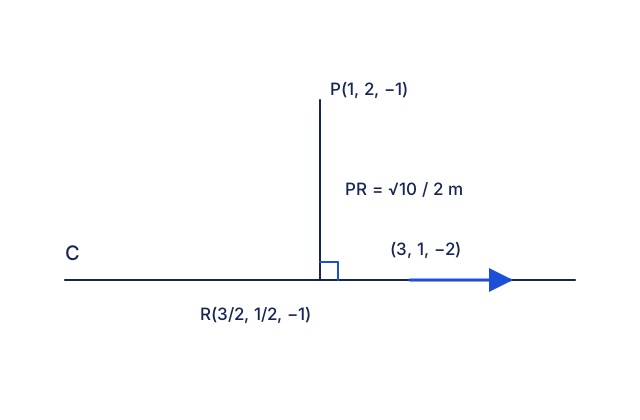
(iii) Method 3: perpendicular foot
The shortest connector to a line is perpendicular to its direction. With ,
Thus . This is allowed even if C is restricted to its forward ray.
(iii) Evaluate the minimum
All methods give
Compare your sketch
Expand diagramFit diagram to page
Use the scrollbars or arrow keys to inspect details.
Common mistakes
The full-line convention in part (i) matters: its computed parameter is negative. Keep that source modelling ambiguity explicit.
Solution notes
All printed asks, complete-square and discriminant arguments, three minimisation methods with both derivative variants, two sign charts and the perpendicular-foot sketch retained. The original vertex-height slip 1/28 is qualified; the correct value is 1/8. Source cable wording interpreted conditionally as full supporting lines, not silently changed to a forward ray.