Porisma

Worked solution

Three forms of a plane in four settings

Find the vector equations of the plane Π\Pi in parametric form and scalar product form, and also the Cartesian equation of the plane Π\Pi if

(a) Π\Pi passes through the three points A(1,0,2)A(1,0,2), B(0,1,3)B(0,1,3), C(2,−1,4)C(2,-1,4).

(b) Π\Pi contains the two lines l1:r=(1+λ)i+(1+2λ)j−λkl_1:\mathbf r=(1+\lambda)\mathbf i+(1+2\lambda)\mathbf j-\lambda\mathbf k, λ∈R\lambda\in\mathbb R, and l2:r=(2−μ)i+μj+(2−2μ)kl_2:\mathbf r=(2-\mu)\mathbf i+\mu\mathbf j+(2-2\mu)\mathbf k, μ∈R\mu\in\mathbb R.

(c) Π\Pi contains the point D(1,−1,2)D(1,-1,2) and the line l:r=(1+3λ)i−(1+2λ)j+6λkl:\mathbf r=(1+3\lambda)\mathbf i-(1+2\lambda)\mathbf j+6\lambda\mathbf k, λ∈R\lambda\in\mathbb R.

(d) Π\Pi contains the point A(1,0,2)A(1,0,2) and parallel to the y-z plane.

CJC · Discussion · Question 1

Answer

(a) x+y=1x+y=1; (b) −x+y+z=0-x+y+z=0; (c) 2x+3y=−12x+3y=-1; (d) x=1x=1, with parametric and scalar forms in the working.

(a) Three points

AB=(−1,1,1)AB=(-1,1,1) and AC=(1,−1,2)AC=(1,-1,2). Their cross product is (3,3,0)=3(1,1,0)(3,3,0)=3(1,1,0). Thus

r=(1,0,2)+s(−1,1,1)+t(1,−1,2).\begin{aligned}&\mathbf r\\ & =(1,0,2)+s(-1,1,1)\\ &{}+t(1,-1,2).\end{aligned}

The scalar form is r⋅(1,1,0)=(1,0,2)⋅(1,1,0)=1\mathbf r\cdot(1,1,0)=(1,0,2)\cdot(1,1,0)=1, hence x+y=1x+y=1.

How did this part go?

(b) Two contained lines

The directions are (1,2,−1)(1,2,-1) and (−1,1,−2)(-1,1,-2); their cross product is (−3,3,3)=3(−1,1,1)(-3,3,3)=3(-1,1,1). The first base point (1,1,0)(1,1,0) lies on both lines (parameters 0 and 1). Therefore

r=(1,1,0)+s(1,2,−1)+t(−1,1,−2).\begin{aligned}&\mathbf r\\ & =(1,1,0)+s(1,2,-1)\\ &{}+t(-1,1,-2).\end{aligned}

Scalar form r⋅(−1,1,1)=0\mathbf r\cdot(-1,1,1)=0 gives −x+y+z=0-x+y+z=0. The other base point (2,0,2)(2,0,2) also satisfies this plane.

How did this part go?

(c) A line and an external point

The line is based at (1,−1,0)(1,-1,0) with direction (3,−2,6)(3,-2,6). The displacement to D is (0,0,2)=2(0,0,1)(0,0,2)=2(0,0,1). Thus

r=(1,−1,0)+s(3,−2,6)+t(0,0,1).\begin{aligned}&\mathbf r\\ & =(1,-1,0)+s(3,-2,6)\\ &{}+t(0,0,1).\end{aligned}

The direction cross product is (−2,−3,0)=−(2,3,0)(-2,-3,0)=-(2,3,0), so scalar form is r⋅(2,3,0)=−1\mathbf r\cdot(2,3,0)=-1, and Cartesian form 2x+3y=−12x+3y=-1.

How did this part go?

(d) Parallel to the y-z plane

Use directions (0,1,0)(0,1,0) and (0,0,1)(0,0,1), with cross product (1,0,0)(1,0,0). Then

r=(1,0,2)+s(0,1,0)+t(0,0,1).\begin{aligned}&\mathbf r\\ & =(1,0,2)+s(0,1,0)\\ &{}+t(0,0,1).\end{aligned}

The scalar equation r⋅(1,0,0)=1\mathbf r\cdot(1,0,0)=1 gives x=1x=1. All s,t parameters above range independently over the real numbers.

How did this part go?

Compare your sketch

Expand diagram

Use the scrollbars or arrow keys to inspect details.
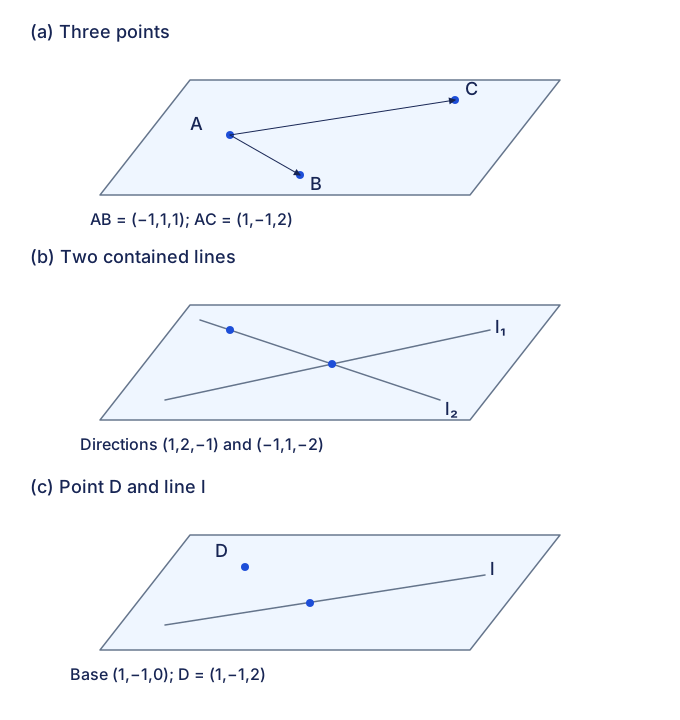
Three labelled planar schematics. In a, arrows AB and AC join A(1,0,2) to B(0,1,3) and C(2,-1,4). In b, contained lines l1 and l2 intersect and have independent directions (1,2,-1),(-1,1,-2). In c, D(1,-1,2) is off the line based at (1,-1,0), giving the second plane direction (0,0,1). Part d needs only x=1 and is explained algebraically. Shapes are finite illustration patches of infinite planes.

Common mistakes

Two arbitrary spatial line directions do not by themselves prove that their lines share a plane. Here the common point in (b) is checked.

Solution notes

All four subparts and all three requested forms retained. The three source solution schematics are independently reconstructed as planar illustrations, not coordinate projections.

Read the hint