Porisma

Worked solution

Use a plane normal to measure distance and construct a perpendicular plane

The line ll passes through A(−1,2,3)A(-1,2,3) and B(5,14,11)B(5,14,11). The plane pp has equation 2x+3y−6z=−72x+3y-6z=-7.

(i) Show ll is parallel to, but not contained in, pp.

(ii) Find the distance of ll from pp.

(iii) Find a Cartesian equation of the plane containing ll and perpendicular to pp.

[2010/JJC/I/7]

CJC · Discussion · Question 3

Answer

(ii) 11 unit; (iii) −48x+26y−3z=91-48x+26y-3z=91.

(i) Check direction and base point separately

AB→=(6,12,8)=2(3,6,4)\overrightarrow{AB}=(6,12,8)=2(3,6,4), so l:r=(−1,2,3)+λ(3,6,4)l:\mathbf r=(-1,2,3)+\lambda(3,6,4). The plane normal is (2,3,−6)(2,3,-6). Its dot product with the line direction is 6+18−24=06+18-24=0. But (−1,2,3)⋅(2,3,−6)=−14≠−7(-1,2,3)\cdot(2,3,-6)=-14\ne-7, so the line is parallel and not contained.

How did this part go?

(ii) Project a connecting vector onto the unit normal

Choose Q=(−7/2,0,0)Q=(-7/2,0,0) on pp. Then QA→=(5/2,2,3)\overrightarrow{QA}=(5/2,2,3) and the normal magnitude is 77. The perpendicular distance is ∣QA→⋅(2,3,−6)/7∣=∣5+6−18∣/7=1|\overrightarrow{QA}\cdot(2,3,-6)/7|=|5+6-18|/7=1 unit. The source schematic joins Q to A obliquely and labels the perpendicular height separately; QA itself is not the distance.

How did this part go?

(iii) Span the new plane by the line direction and the old normal

The required plane contains d=(3,6,4)\mathbf d=(3,6,4) and np=(2,3,−6)\mathbf n_p=(2,3,-6) as directions, hence r=(−1,2,3)+s(3,6,4)+t(2,3,−6)\mathbf r=(-1,2,3)+s(3,6,4)+t(2,3,-6). Their cross product is (−48,26,−3)(-48,26,-3), giving r⋅(−48,26,−3)=48+52−9=91\mathbf r\cdot(-48,26,-3)=48+52-9=91. Thus −48x+26y−3z=91-48x+26y-3z=91. Its normal is orthogonal to the old normal, as required.

How did this part go?

Compare your sketch

Expand diagram

Use the scrollbars or arrow keys to inspect details.
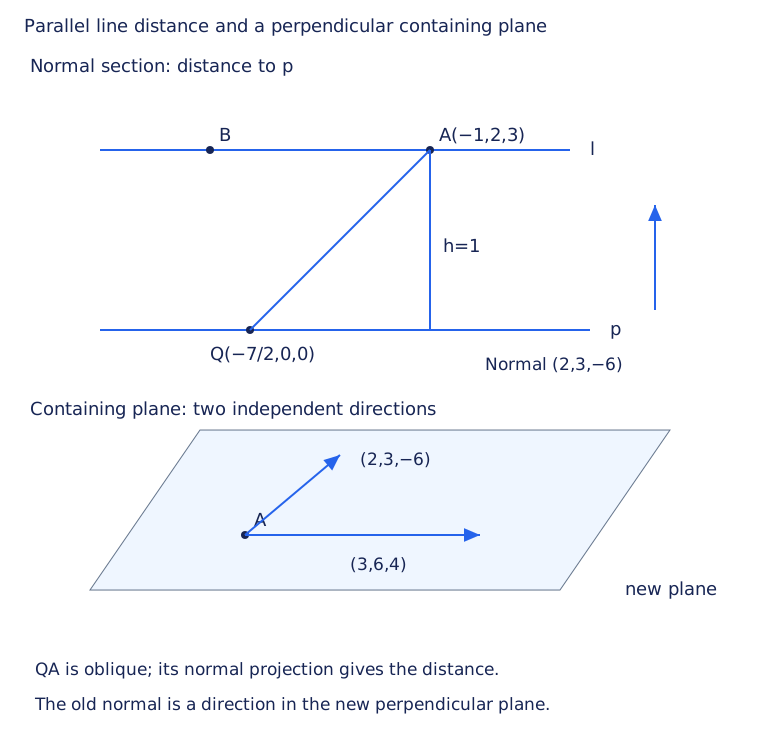
Two schematics: a line l parallel above plane p with normal height h and oblique connector QA; then the new plane containing l and the direction normal to p. Labels retain A, B, Q, directions (3,6,4) and (2,3,-6).

Common mistakes

Measure the normal projection of a connecting vector, not its full oblique length.

Read the hint