Porisma

Worked solution

Equate absolute normal distances to two intersecting planes

The planes p1:r⋅(2,−2,1)=1p_1:\mathbf r\cdot(2,-2,1)=1 and p2:r⋅(−6,3,2)=−1p_2:\mathbf r\cdot(-6,3,2)=-1 meet in line l.

(i) Find the acute angle between the planes.

(ii) Find a vector equation for l.

(iii) A(4,3,c)A(4,3,c) is equidistant from the two planes. Calculate both possible values of c.

[2013/II/4]

CJC · Discussion · Question 7

Answer

Angle 40.4∘40.4^\circ; line r=(−1/6,−2/3,0)+λ(7/6,5/3,1)\mathbf r=(-1/6,-2/3,0)+\lambda(7/6,5/3,1); c=−49c=-49 or 35/1335/13.

(i) Compare the normals

The normal lengths are 3 and 7, and the dot product is −12−6+2=−16-12-6+2=-16. Thus θ=cos⁡−1(16/21)≈40.4∘\theta=\cos^{-1}(16/21)\approx40.4^\circ.

How did this part go?

(ii) Solve for two coordinates in terms of the third

2x−2y+z=12x-2y+z=1 and −6x+3y+2z=−1-6x+3y+2z=-1 give x=−1/6+7z/6x=-1/6+7z/6, y=−2/3+5z/3y=-2/3+5z/3. Hence r=(−1/6,−2/3,0)+λ(7/6,5/3,1)\mathbf r=(-1/6,-2/3,0)+\lambda(7/6,5/3,1), λ∈R\lambda\in\mathbb R.

How did this part go?

(iii) Project from a point common to both planes

Choose Q=(−1/6,−2/3,0)Q=(-1/6,-2/3,0) on the intersection. Then QA→=(25/6,11/3,c)\overrightarrow{QA}=(25/6,11/3,c). The distances are h1=∣QA→⋅(2,−2,1)∣/3=∣1+c∣/3h_1=|\overrightarrow{QA}\cdot(2,-2,1)|/3=|1+c|/3 and h2=∣QA→⋅(−6,3,2)∣/7=2∣c−7∣/7h_2=|\overrightarrow{QA}\cdot(-6,3,2)|/7=2|c-7|/7.

How did this part go?

(iii) Retain both signs

Equating and squaring gives [7(1+c)]2−[6(c−7)]2=0[7(1+c)]^2-[6(c-7)]^2=0. Factoring the difference of squares gives [7+7c−6c+42][7+7c+6c−42]=(c+49)(13c−35)=0[7+7c-6c+42][7+7c+6c-42]=(c+49)(13c-35)=0. Thus c=−49c=-49 or 35/1335/13. Both satisfy the original absolute-distance equation.

How did this part go?

Compare your sketch

Expand diagram

Use the scrollbars or arrow keys to inspect details.
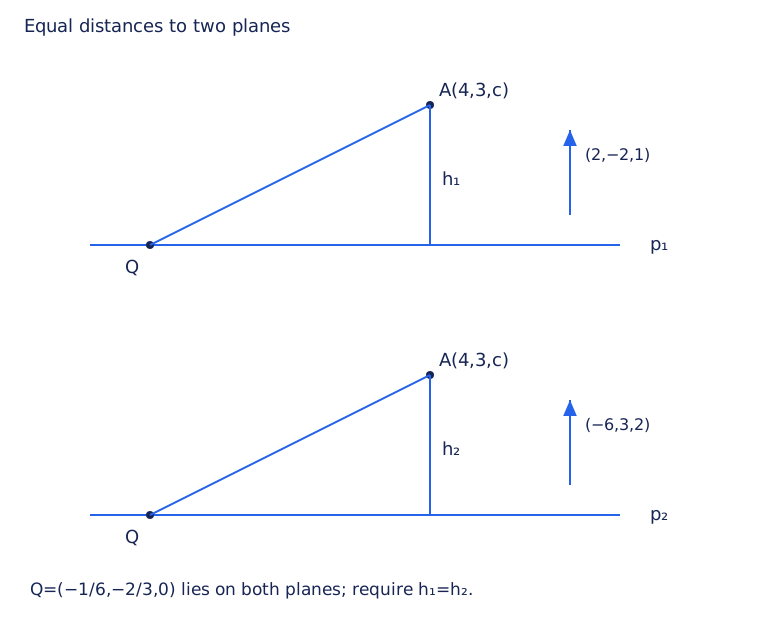
Two normal-section sketches share Q on the intersection and A(4,3,c); each plane has its own perpendicular height h1 or h2 and labelled normal (2,-2,1) or (-6,3,2). The equal-distance requirement is h1=h2.

Common mistakes

Dropping the absolute values can lose one of the two angle-bisector planes.

Read the hint