Discussion questions · Section 2 of 2
Questions 7–10 in this collection
Equate absolute normal distances to two intersecting planes · Separate a unique triple intersection from a common line · +2 more
- 7
The planes and meet in line l.
(i) Find the acute angle between the planes.
(ii) Find a vector equation for l.
(iii) is equidistant from the two planes. Calculate both possible values of c.
[2013/II/4]
CJC · Discussion · Question 7
- 8
The planes are , , , respectively. Here are constants. When , , find x,y,z satisfying all three equations.
The first two planes meet in a line l.
(i) Find a vector equation of l.
(ii) If contains l, find .
(iii) If instead does not intersect l, what can be said about ?
(iv) Find a Cartesian equation of the plane containing l and .
[2008/I/11(modified)]
CJC · Discussion · Question 8
- 9
(a) Points P,Q,R have position vectors . P and Q are fixed; R varies. Given , , and , find the relation between x,y,z and describe the locus of R.
(b) Interpret geometrically, where is a constant unit vector and d is a constant scalar. State what d represents.
(c) Given , solve and for t in terms of . Interpret the solution geometrically.
[2017&2020/I/(modified)]
CJC · Discussion · Question 9
- 10
A right opaque pyramid has square base ABCD at ground level, centre O and vertex V. Perpendicular unit vectors point along AB, AD, OV, respectively. AB has length 8 and OV has length 2h. A point light source is at . A screen of height 35 has its base on the ground and lies in , where , as shown.
(i) Find a vector equation for the line depicting the light ray from P to V, in terms of h. marks
(ii) Find an inequality between so the pyramid’s shadow does not exceed the screen height. marks
The point light is now replaced by parallel light rays perpendicular to the screen; also .
(iii) Find the exact length of the shadow cast by edge VB on the screen. marks
A mirror is placed on plane VBC.
(iv) Find a vector equation of plane VBC and hence the mirror’s inclination to the ground. marks
Expand diagramFit diagram to page
Use the scrollbars or arrow keys to inspect details.
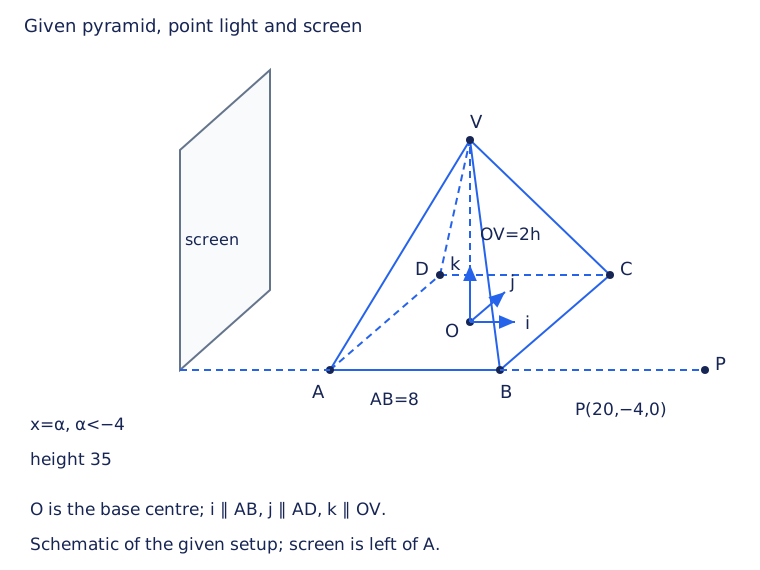
Given setup: square ABCD on the ground centred at O, vertex V vertically above O, i along AB, j along AD, k along OV. P(20,-4,0) is beyond B on the AB ground line. The screen stands on x=alpha less than -4 and has height 35; base AB=8 and OV=2h. [2017/RI/I/11]
CJC · Discussion · Question 10