Porisma

Worked solution

Separate a unique triple intersection from a common line

The planes p1,p2,p3p_1,p_2,p_3 are 2x−5y+3z=32x-5y+3z=3, 3x+2y−5z=−53x+2y-5z=-5, 5x+λy+17z=μ5x+\lambda y+17z=\mu, respectively. Here λ,μ\lambda,\mu are constants. When λ=−20.9\lambda=-20.9, μ=16.6\mu=16.6, find x,y,z satisfying all three equations.

The first two planes meet in a line l.

(i) Find a vector equation of l.

(ii) If p3p_3 contains l, find λ,μ\lambda,\mu.

(iii) If instead p3p_3 does not intersect l, what can be said about λ,μ\lambda,\mu?

(iv) Find a Cartesian equation of the plane containing l and (1,−1,3)(1,-1,3).

[2008/I/11(modified)]

CJC · Discussion · Question 8

Answer

Opening (−4/11,−4/11,7/11)(-4/11,-4/11,7/11); (i) r=(−1,−1,0)+s(1,1,1)\mathbf r=(-1,-1,0)+s(1,1,1); (ii) λ=−22,μ=17\lambda=-22,\mu=17; (iii) λ=−22,μ≠17\lambda=-22,\mu\ne17; (iv) 3x−y−2z=−23x-y-2z=-2.

Opening ask: solve the three stated equations

For λ=−20.9\lambda=-20.9, μ=16.6\mu=16.6, the solution is (x,y,z)=(−4/11,−4/11,7/11)(x,y,z)=(-4/11,-4/11,7/11). It satisfies both first planes; in the third, 5(−4/11)−20.9(−4/11)+17(7/11)=16.65(-4/11)-20.9(-4/11)+17(7/11)=16.6. The terminating decimals are treated as the exact data printed.

How did this part go?

(i) Parameterise the first two planes’ common line

Solving the first two equations gives x=−1+zx=-1+z, y=−1+zy=-1+z. Thus l:r=(−1,−1,0)+s(1,1,1)l:\mathbf r=(-1,-1,0)+s(1,1,1), s∈Rs\in\mathbb R.

How did this part go?

(ii) Require direction parallelism and a contained point

For l to lie in p3p_3, (1,1,1)⋅(5,λ,17)=0(1,1,1)\cdot(5,\lambda,17)=0, giving 5+λ+17=05+\lambda+17=0, so λ=−22\lambda=-22. The base point must also lie in p3p_3: μ=(−1,−1,0)⋅(5,−22,17)=17\mu=(-1,-1,0)\cdot(5,-22,17)=17.

How did this part go?

(iii) Retain parallelism but exclude the base point

For no intersection, the direction must still be parallel, so λ=−22\lambda=-22, but the point must fail the plane equation, giving μ≠17\mu\ne17. Otherwise if λ≠−22\lambda\ne-22, substitution along the line yields exactly one intersection.

How did this part go?

(iv) Span the plane and find its normal

The displacement from (−1,−1,0)(-1,-1,0) to (1,−1,3)(1,-1,3) is (2,0,3)(2,0,3). Thus the plane is r=(−1,−1,0)+s(1,1,1)+t(2,0,3)\mathbf r=(-1,-1,0)+s(1,1,1)+t(2,0,3). Its normal is (1,1,1)×(2,0,3)=(3,−1,−2)(1,1,1)\times(2,0,3)=(3,-1,-2), and its scalar constant is −3+1=−2-3+1=-2. Hence 3x−y−2z=−23x-y-2z=-2.

How did this part go?

Compare your sketch

Expand diagram

Use the scrollbars or arrow keys to inspect details.
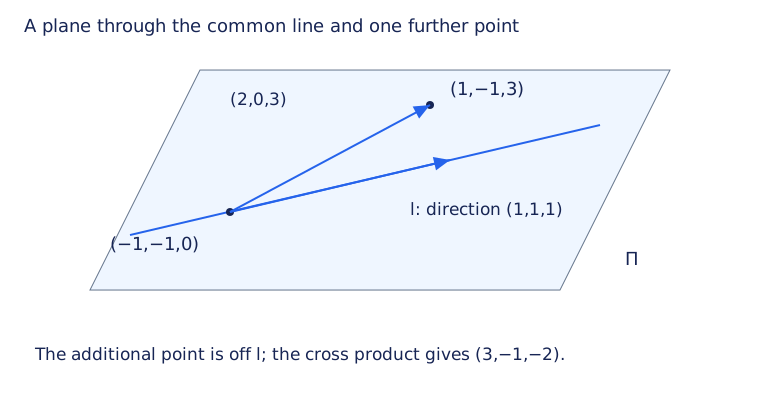
A finite patch of the required plane contains line l through (-1,-1,0) in direction (1,1,1), and the point (1,-1,3) off that line. A second spanning arrow has direction (2,0,3).

Common mistakes

The initial numerical triple-intersection ask is separate from parts (i)–(iv) and must also be answered.

Read the hint