Porisma

Worked solution

Question 2

The curve CC has equation y=x2+ax+bc−xy=\dfrac{x^2+ax+b}{c-x}. The vertical asymptote of CC is x=−2x=-2, and the coordinates of the turning points are (−4,2)(-4,2) and (0,−6)(0,-6).

(i) Find the values of aa, bb and cc. marks

(ii) Sketch CC, stating the equations of the asymptotes. marks

(iii) By drawing an appropriate graph on the sketch of CC, find the range of values of kk (k>0)(k>0) such that the equation (x+4)2+(x2+ax+bc−x)2=k2(x+4)^2+\left(\dfrac{x^2+ax+b}{c-x}\right)^2=k^2 has no real roots. marks

(iv) When CC undergoes a translation in the direction of the yy-axis by pp units, CC intersects the line y=−1y=-1 at one negative value of xx. State the set of values for pp. marks

2013/PJC/II/5

Answer

(i) a=6a=6, b=12b=12, c=−2c=-2.

(ii) The asymptotes are x=−2x=-2 and y=−x−4y=-x-4. The curve has turning points (−4,2)(-4,2) and (0,−6)(0,-6).

(iii) 0<k<20<k<2.

(iv) {p∈R: p=−3 or p>5}\{p\in\mathbb R:\ p=-3\ \text{or}\ p>5\}.

Compare your reasoning

(i) x=−2x=-2 is the vertical asymptote, so c=−2c=-2. The point (0,−6)(0,-6) gives −6=b−2-6=\dfrac{b}{-2}, so b=12b=12. The point (−4,2)(-4,2) gives 2=16−4a+1222=\dfrac{16-4a+12}{2}, so −4a+b=−12-4a+b=-12 and a=6a=6.

(ii) x2+6x+12−2−x=−(x+4)−4x+2\dfrac{x^2+6x+12}{-2-x}=-(x+4)-\dfrac{4}{x+2}, so the oblique asymptote is y=−x−4y=-x-4.

(iii) The equation is (x+4)2+y2=k2(x+4)^2+y^2=k^2, a circle of radius kk centred at (−4,0)(-4,0). It meets CC nowhere when its radius is less than the distance 2 to the turning point (−4,2)(-4,2), so 0<k<20<k<2.

(iv) Translating by pp means solving f(x)=−1−pf(x)=-1-p for one negative xx. Translating down by 3 makes the left branch just touch y=−1y=-1 at x=−4x=-4, so p=−3p=-3. Translating up by more than 5 lifts the right-hand maximum −6-6 above −1-1, so the line meets that branch once, at a negative xx: p>5p>5.

How did this question go?

Compare your sketch

Expand diagram

Use the scrollbars or arrow keys to inspect details.
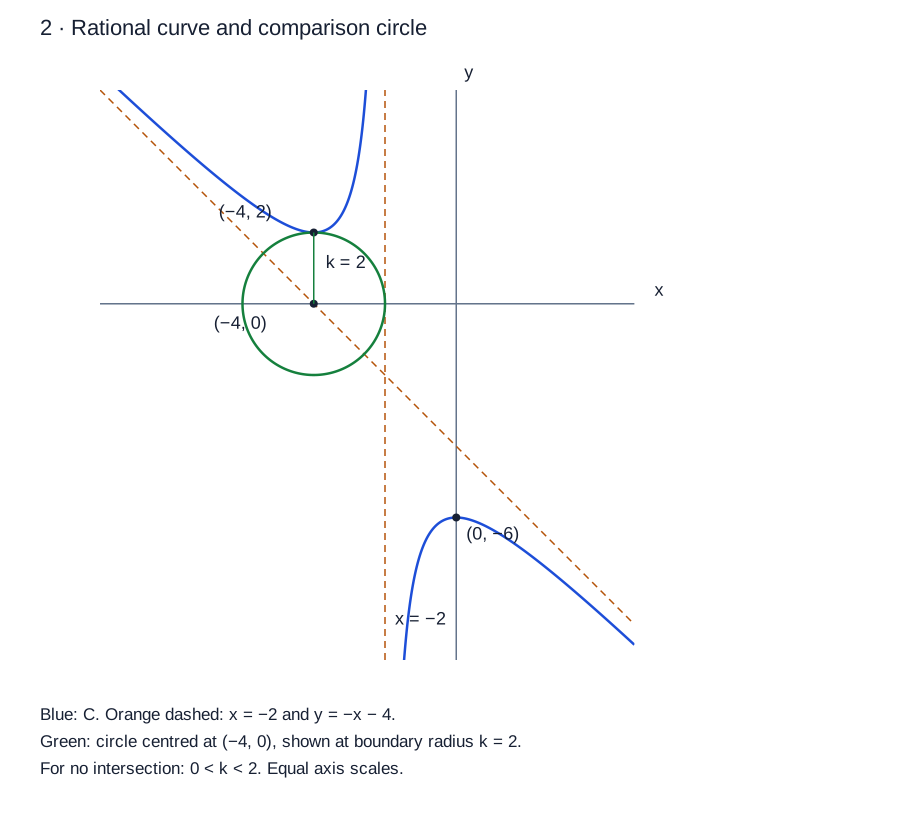
Curve y = −x − 4 − 4/(x + 2), with turning points (−4, 2) and (0, −6), asymptotes x = −2 and y = −x − 4. A radius-2 circle centred at (−4, 0) touches the left branch at (−4, 2); smaller positive radii give no intersections.