Review practice
- 1
Sketch the curve with equation , indicating clearly the equation of any asymptote (s) and the coordinates of any stationary point (s). marks
2012/HCI/Promo/12(a)
- 2
The curve has equation . The vertical asymptote of is , and the coordinates of the turning points are and .
(i) Find the values of , and . marks
(ii) Sketch , stating the equations of the asymptotes. marks
(iii) By drawing an appropriate graph on the sketch of , find the range of values of such that the equation has no real roots. marks
(iv) When undergoes a translation in the direction of the -axis by units, intersects the line at one negative value of . State the set of values for . marks
2013/PJC/II/5
- 3
The circle with equation , where is a real constant, intersects the parabola with equation at four distinct points. Determine the range of values of . marks
2013/RI/JC1/MYE/2
- 4
The curve has equation and the curve has equation .
(i) Sketch and on the same diagram, indicating clearly the axial intercepts and the equations of any asymptotes. marks
(ii) Find the -coordinate(s) of the point (s) of intersection of and . mark
(iii) Hence solve the inequality . marks
2014/SRJC/JC1/MYE/4
- 5
The graph of , , underwent exactly two simple transformations, involving either reflection, stretching or translation only, to become the ellipse that passes through , , and .
(i) Write down the equation of the ellipse. marks
(ii) Describe clearly (in words) a sequence of the two transformations. mark
Expand diagramFit diagram to page
Use the scrollbars or arrow keys to inspect details.
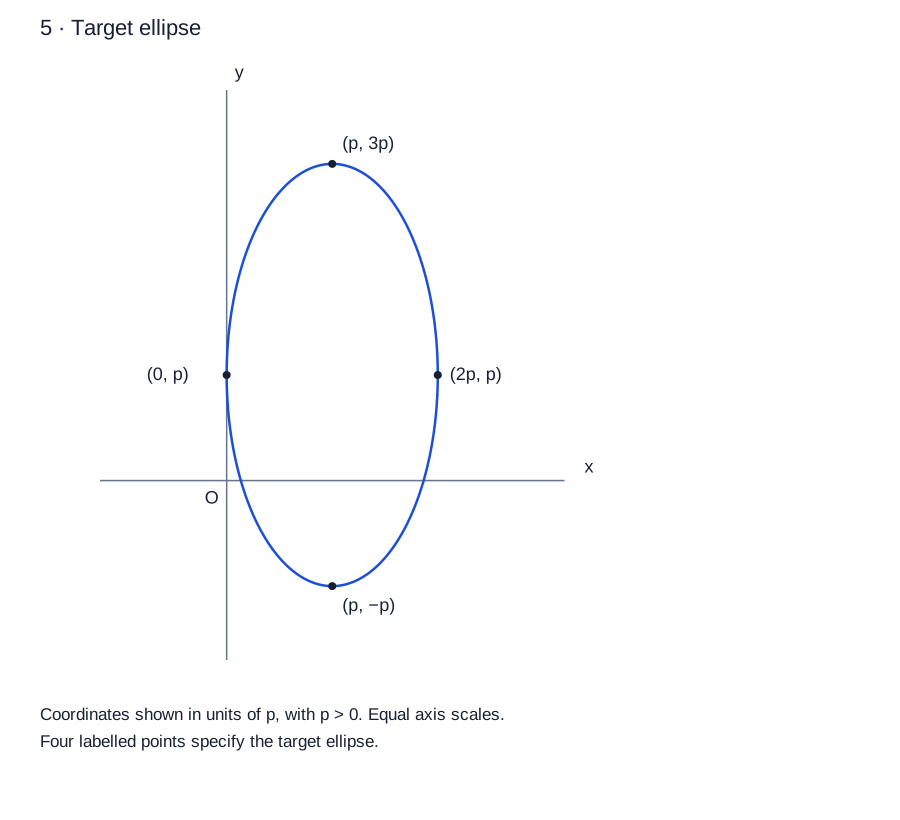
Target ellipse centred at (p, p) for p > 0, through (0, p), (2p, p), (p, 3p), (p, −p). The horizontal semi-axis is p and vertical semi-axis 2p. 2010/RI/Promo/5(b)
- 6
(a) The curve has equation . Sketch , giving the equations of any asymptotes, coordinates of its centre and the vertices. marks
(b) The curve has equation , , , . Find the range of values of for which the graph of is strictly increasing. marks
2016/Promo/NYJC/5
- 7
A tunnel is built to facilitate the transportation of goods by trains between Country and Country . Due to differences in the rail systems between the two countries, two types of tracks are used: the international track with track gauge of 1435 mm and the narrow track with track gauge of 1000 mm (in rail transport, track gauge is the spacing on a railway track). It is known that the cross-section of the tunnel is a half ellipse with centre and width . The maximum height of the tunnel is 2000 mm. To standardize the volumes of the goods to be transported, the areas and are made equal. Find the width of the tunnel , giving your answer to the nearest mm.
In the diagram, is the midpoint of the base . and lie on the base, 1000 mm apart and symmetric about , with and on the tunnel wall directly above them. and lie on the base, 1435 mm apart and symmetric about , with and on the tunnel wall directly above them.
Expand diagramFit diagram to page
Use the scrollbars or arrow keys to inspect details.
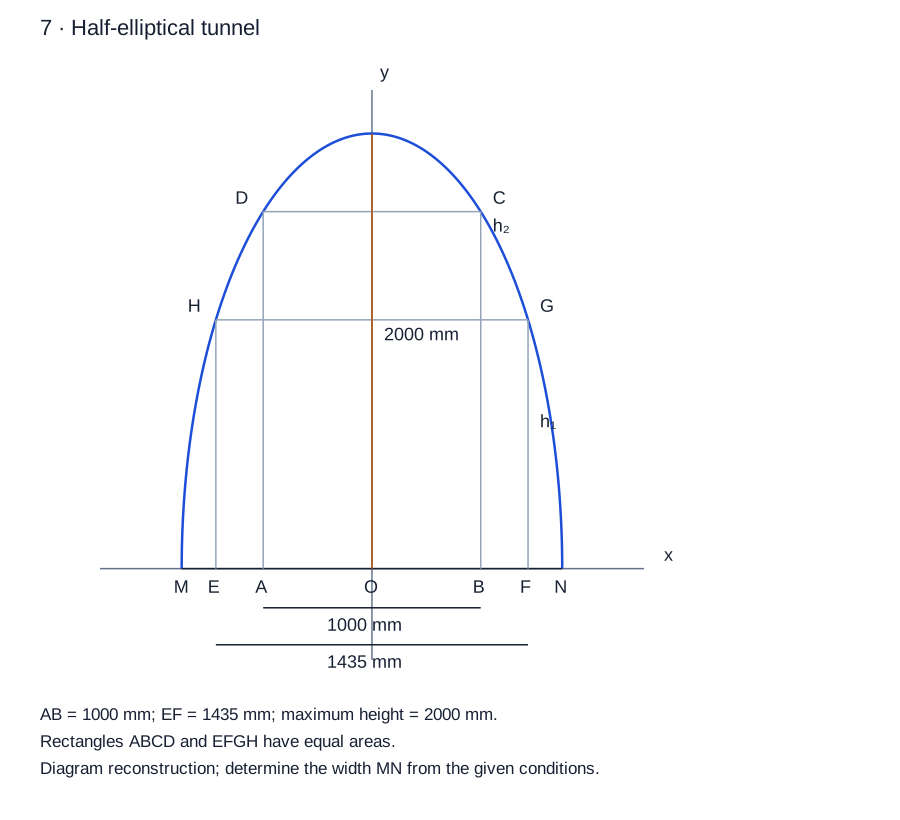
Half ellipse of maximum height 2000 mm and base MN, centred at O. Along the base from left to right are M, E, A, O, B, F, N. A and B are 1000 mm apart; E and F are 1435 mm apart. D and C are vertically above A and B; H and G above E and F. Rectangles ABCD and EFGH have equal areas. BC = h₂ and FG = h₁. 2015/HCI/Prelim/I/3