Porisma

Worked solution

Question 3

The circle with equation x2+(y−k)2=25x^2+(y-k)^2=25, where kk is a real constant, intersects the parabola with equation 4y=x24y=x^2 at four distinct points. Determine the range of values of kk. marks

2013/RI/JC1/MYE/2

Answer

5<k<2945<k<\dfrac{29}{4}.

Compare your reasoning

Substitute x2=4yx^2=4y: 4y+(y−k)2=254y+(y-k)^2=25, so y2+(4−2k)y+k2−25=0y^2+(4-2k)y+k^2-25=0.

For two distinct values of yy, the discriminant must be positive:

(4−2k)2−4(k2−25)=116−16k>0⟹k<294.(4-2k)^2-4(k^2-25)=116-16k>0\quad\Longrightarrow\quad k<\tfrac{29}{4}.

Each positive yy gives two points on the parabola, so both roots must be positive. The lowest point of the circle is at y=k−5y=k-5, which must be above the origin: k−5>0k-5>0, so k>5k>5.

Both roots must be positive: their sum is 2k−4>02k-4>0 and product k2−25>0k^2-25>0. Together these imply k>5k>5. This supplies the algebraic justification for the source sketch; the discriminant condition then gives 5<k<29/45<k<29/4.

How did this question go?

Compare your sketch

Expand diagram

Use the scrollbars or arrow keys to inspect details.
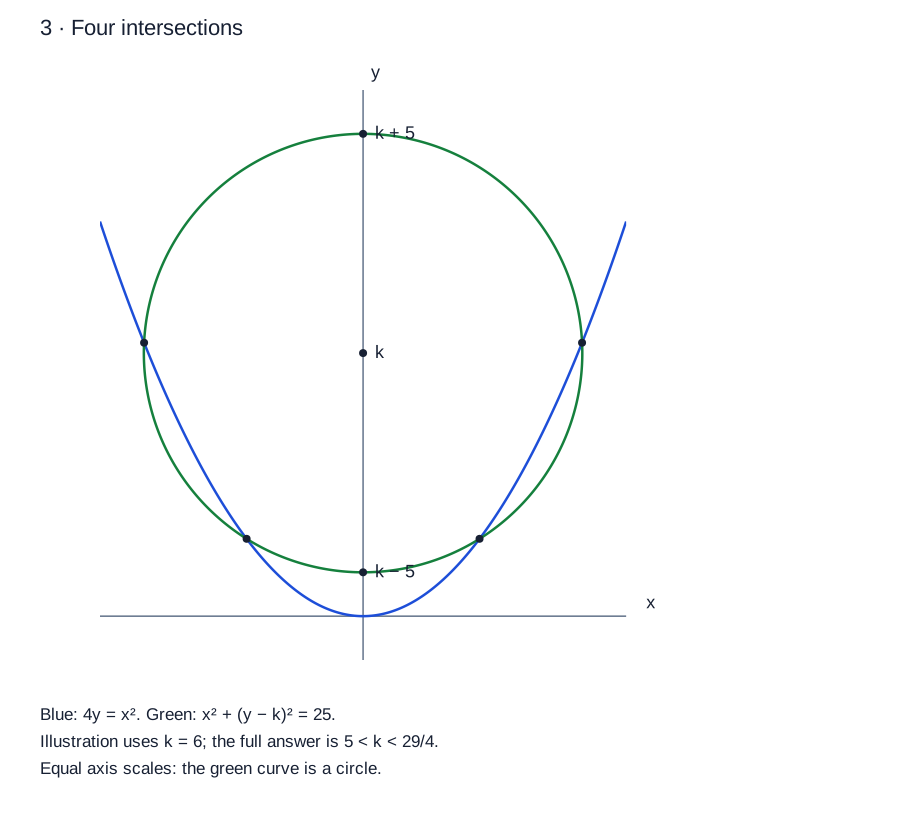
Illustrative k = 6: circle x² + (y − 6)² = 25 and parabola 4y = x² meet at four distinct points. Circle intercepts on the y-axis are k − 5 and k + 5, with centre (0, k). The required range is 5 < k < 29/4.